Current Native American Voting Rights and Political Activism
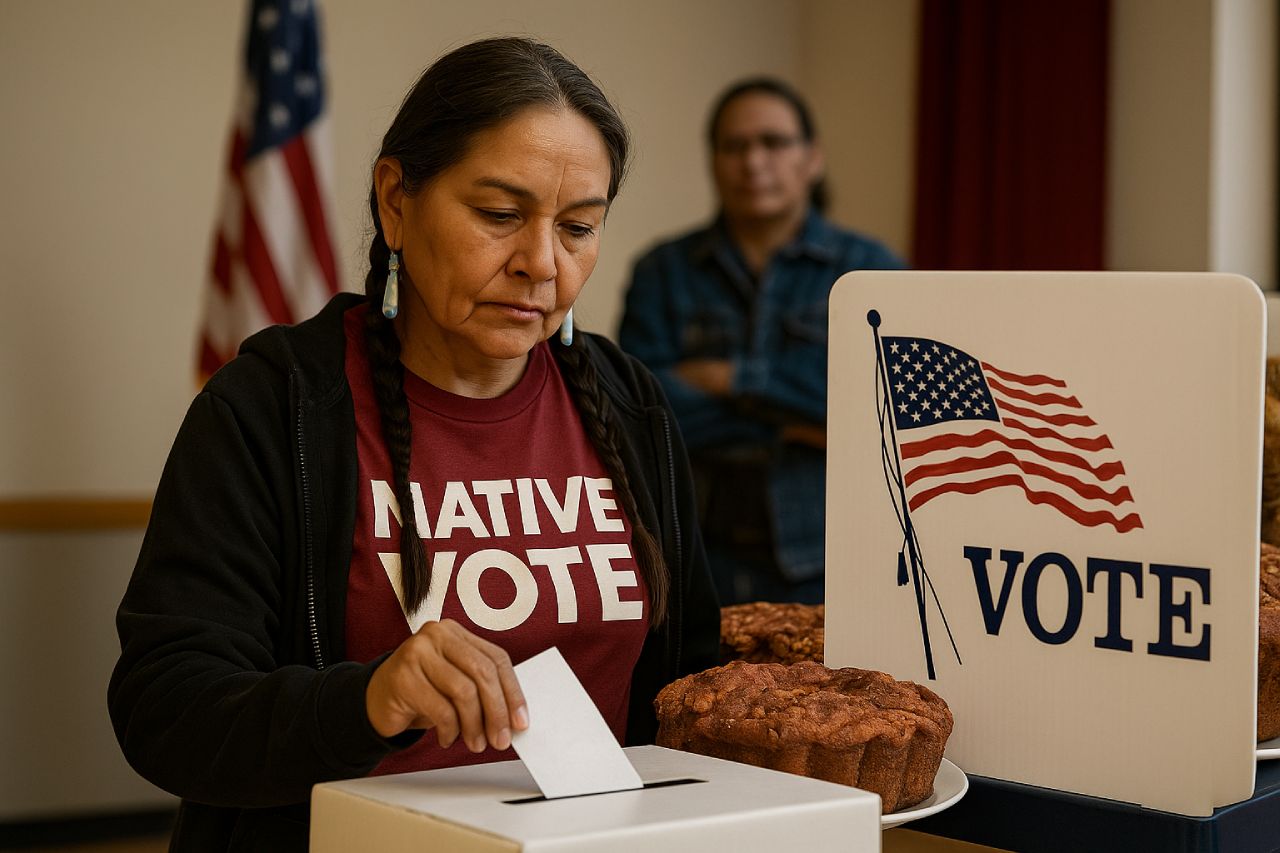
In the mid-2020s, one thing has become impossible to ignore: the Native vote is not just a demographic—it is a deciding factor. In presidential battlegrounds like Arizona, Wisconsin, Nevada, and Michigan, the number of eligible Native voters exceeds recent margins of victory, meaning Native turnout can literally flip outcomes.
Yet even as candidates court Indigenous communities and more Native people run for office, Native voters still face some of the steepest barriers to the ballot box of any group in the United States—from long drives over unpaved roads to rigid ID rules that don’t recognize how homes on tribal lands are addressed. The Native American Rights Fund (NARF) has documented these barriers in detail, describing “obstacles at every turn” during registration, voting, and vote counting.
As we move into 2026 and beyond, the paradox is clear:
- Indigenous political power is growing,
- but systemic barriers are still designed around urban, non-Native realities.
Thesis: Despite strict ID laws, geographic isolation, and rules that disregard life on reservations, Indigenous political action is surging—fueled by grassroots organizing, landmark litigation, and a renewed push for federal protections like the Native American Voting Rights Act (NAVRA). The Native vote is about more than partisan politics; it is a civil right and a modern expression of sovereignty.
The “Tyranny of Distance”: Voting Access on Reservations
Geography: When the Poll Is Hours Away
For many Native voters, the right to vote is limited not just by law, but by distance and infrastructure.
NARF’s Obstacles at Every Turn report and later analyses found that Native voters often must travel long distances—over unpaved or poorly maintained roads—to reach registration sites or polling places, and in some areas the round trip can easily run two to four hours.
Case studies from places like the Fort Peck Reservation in Montana and rural Alaska show that counties sometimes locate polling sites far from reservation population centers, forcing voters without cars to rely on carpools or costly rides.
A 2024 Brennan Center analysis of voting on tribal lands found that turnout on tribal lands was, on average, 11 percentage points lower than in surrounding non-tribal areas from 2012–2022—and identified distance, poor roads, and limited early-voting options as key factors.
Mail Service & PO Boxes: Democracy by Post Office Line
Mail voting, which many states have expanded since 2020, is not automatically a solution in Indian Country.
A 2024 NARF study, Disconnected Democracy, showed that areas with higher Native American populations tend to have less reliable residential mail delivery, forcing many households to rely on shared PO boxes at distant post offices.
The federal Election Assistance Commission’s case studies on Native voting likewise identify non-traditional mailing addresses and poor mail service as major barriers: when a tribe designates a ballot pickup site or community building, some states still refuse to recognize it as a valid address for voter registration or mail ballot delivery.
For elders, people without cars, or residents living “farther up the dirt road,” this means voting by mail can require multiple trips to a distant PO box, during limited office hours, often in bad weather.
The “Addressing” Problem: When Homes Don’t Fit the Form
Most state voter registration systems assume a standard street address—a number and street name that can be matched by a computer to a precinct map. But many homes on reservations do not have that kind of address.
NARF and the National Conference of State Legislatures (NCSL) both highlight that on many reservations, people use descriptive directions (“two miles past the clinic, turn at the water tower”) or landmarks to identify their homes. When these directions are forced into standardized forms, they can be rejected or mis-geocoded, leading to:
- Registration denials, because the system cannot validate the address;
- Wrong precinct assignments, forcing voters to cast provisional ballots;
- Confusion when election officials insist on a “real” address that simply doesn’t exist in the 911 system.
A 2024 Reuters piece on Native voters in Arizona documented how address and documentation mismatches—often caused by non-standard physical locations and PO boxes—pushed Native voters into provisional status or left them unsure whether their ballot would count.
NARF has responded by publishing “Addressing: A Guide for Tribes,” helping tribal governments build address systems that meet USPS and state election database requirements without erasing local realities.
2025–2026 Litigation and Policy Shifts
The fight over geography and access is ongoing in the courts and legislatures:
- In North Dakota, tribes challenged a redistricting map that “packed” and “cracked” Native voters from Turtle Mountain and Spirit Lake, arguing it diluted Native voting strength under the Voting Rights Act. A federal court agreed, but an appeals court later reversed; tribes are now asking the U.S. Supreme Court to step in, and Justice Kavanaugh has temporarily paused the rollback while the case proceeds.
- In Nevada, a 2025 law (SB 421) allows tribes to run their own polling locations for state and federal elections on reservations, reflecting growing recognition that tribal governments should help design how elections function on their lands.
These developments signal where 2026 and later elections are headed: toward a landscape where Native access may either be expanded through collaboration or constrained by court decisions that weaken key protections.
Modern Voter Suppression: Rules That Don’t Match Native Reality
Strict ID Laws & the “Voter Fraud” Narrative
Many of the tightest restrictions Native voters face are justified under the banner of preventing “voter fraud.”
In states like North Dakota and Arizona, laws have required IDs with a residential street address, which many reservation residents do not have. NARF’s litigation in Spirit Lake Tribe v. Jaeger showed that North Dakota’s 2013 voter ID law disproportionately burdened Native voters because the state’s 911 addressing system on reservations was incomplete and error-prone.
At the same time, studies by the Brennan Center for Justice and other researchers consistently find that voter fraud in the U.S. is extremely rare—especially the kind of in-person or mail fraud these laws are supposed to prevent. Large-scale reviews of elections have found only a handful of credible impersonation cases out of hundreds of millions of ballots, with no evidence that fraud has altered major election outcomes.
In practice, this means that rules promoted as “election integrity” measures fall hardest on communities like Native voters, who are most likely to lack the kinds of IDs and standardized addresses those laws assume.
Ballot Collection Bans: A Lifeline Framed as a Threat
On many reservations, ballot collection—sometimes labeled “ballot harvesting” in political debates—is not a luxury; it is a lifeline.
Because home mail delivery is rare, roads are long, and many elders do not drive, tribes and community organizers often rely on trusted community members to pick up and deliver sealed ballots in bulk. NARF and its Native American Voting Rights Coalition emphasize that this practice is essential where post offices are far away or open limited hours.
A 2023 statistical analysis of ballot collection on reservations found no evidence that it increased fraud—and strong evidence that it helped reduce participation gaps between Native and non-Native voters.
Nonetheless, several states have enacted laws that sharply limit who can return someone else’s ballot, or how many ballots one person may carry. After the Supreme Court’s 2021 Brnovich v. DNC decision, Arizona’s restrictions on ballot collection and out-of-precinct voting were upheld despite their disproportionate impact on Native voters.
Redistricting: Cracking and Packing Native Communities
Redistricting is another tool that can dilute Native political power without ever denying anyone the right to vote.
NARF’s Obstacles at Every Turn report and newer cases in North Dakota, Montana, and elsewhere document how maps sometimes:
- “Crack” tribes across multiple districts, so no single district has enough Native voters to elect their candidate of choice; or
- “Pack” several tribal communities into one district, limiting them to a single representative even though their population could support more.
In 2025, for example, the U.S. Supreme Court upheld a North Dakota House district designed to enhance Native voting power on one reservation, while a separate case over a different Native-majority area remains in flux—illustrating how fragile these gains can be.
Language Access: When Ballots Are Not in Our Words
Many Native elders grew up speaking Indigenous languages first, with English as a second language. Section 203 of the Voting Rights Act requires certain jurisdictions to provide language assistance (interpreters, translated materials) for covered languages like Navajo, Yup’ik, or Apache.
However, case studies and lawsuits in Alaska and the Southwest show ongoing non-compliance—poll workers without interpreters, untranslated instructions, or last-minute changes that leave communities scrambling.
The result: elders may technically have the right to vote, but not in a language they fully understand.
The Impact of Indigenous Political Action: The Native “Swing Vote”
The Numbers: More Power Than the Margin of Victory
When you map Native populations onto recent elections, a pattern appears:
- In key states like Arizona, Wisconsin, Nevada, and Michigan, the eligible Native voting population is larger than the statewide margin of victory in close elections.
- Native precincts have delivered margins of 70–90% for certain candidates, helping determine statewide winners in races that came down to tens of thousands—or even a few thousand—votes.
Importantly, Native voters are not monolithic: analyses of the 2024 cycle show Native voters backing candidates from both major parties and from third parties, depending on local issues, treaty rights, and tribal priorities—not just national partisan narratives.
“Indigenizing” the Ballot
The Native vote is not only about turnout; it is about who appears on the ballot in the first place.
- By 2024, at least 170 Indigenous candidates—Native American, Alaska Native, and Native Hawaiian—were on ballots across the United States, an all-time high, from school boards to Congress.
- One analysis found a 300% increase in Native state legislators between 1993 and 2023, reflecting steady growth in representation.
- Native women, in particular, now hold a record number of seats in state legislatures, even though representation still lags behind population share.
Organizations like Advance Native Political Leadership train candidates and staff and track Indigenous runs.
As more Native people serve on school boards, county commissions, and state legislatures, issues like treaty rights, water access, language revitalization, and land stewardship are moving from the margins to the center of policy debates.
Policy Wins: When Turnout Forces a Conversation
High Native turnout has already produced tangible changes:
- In some states, pressure from tribes and Native advocacy organizations has led to additional reservation polling places, ballot drop boxes, and early voting options, often after negotiations or litigation.
- Candidates running statewide have been forced to address Native-specific concerns—such as missing and murdered Indigenous people (MMIP), sacred site protection, and water infrastructure—because Native turnout has become too powerful to ignore.
In other words, the Native vote changes not just who wins, but what gets talked about.
Key Legislative Goals for 2025–2026
The Native American Voting Rights Act (NAVRA)
At the federal level, one bill stands out in Native advocacy circles: the Frank Harrison, Elizabeth Peratrovich, and Miguel Trujillo Native American Voting Rights Act (NAVRA).
Members of Congress have introduced versions of NAVRA in multiple recent Congresses, and Native organizations continue urging the 119th Congress (2025–2027) to finally pass it.
ARF and other experts describe NAVRA as a comprehensive framework tailored to Native voters, proposing to:
- Require states to accept tribal IDs and tribal documentation as valid for voter registration and voting;
- Mandate on-reservation polling places and drop boxes where requested by tribes;
- Recognize non-traditional addresses (including designated tribal buildings) for registration and mail voting;
- Restore a kind of “preclearance” for changes to election laws that disproportionately affect tribes—requiring extra review before such changes take effect;
- Strengthen language-access and outreach obligations in Native communities.
As of late 2025, NAVRA has not yet become law, but it remains a central demand of Native legal advocates heading into the 2026 midterms.
Tribal Sovereignty in Elections
Another emerging trend is the push for tribal control over on-reservation election infrastructure.
- Nevada’s 2025 law (SB 421) gives tribes the ability to run their own polling locations for state and federal elections on their lands, including staffing and administration, in collaboration with county officials.
- The National Congress of American Indians (NCAI) has adopted resolutions calling for tribal equal access to voting, including the power to designate polling sites, drop boxes, and early voting locations on tribal lands with the same technology and support as any other precinct.
Legal scholars have proposed tribal–state compacts on election administration, treating tribes as full partners rather than afterthoughts in designing voting systems.
These efforts all move toward the same idea: voting in Indian Country should be shaped with tribes, not imposed on them.
Grassroots Warriors: Organizations Leading the Fight
The legal and political battles around Native voting rights are not fought in isolation. A network of Native-led and ally organizations is pushing from every angle.
Native American Rights Fund (NARF)
Since 1970, NARF has provided specialized legal assistance to tribes and Native individuals, including leading the Native American Voting Rights Coalition (NAVRC) formed in 2015.
NARF’s work includes:
- Major reports such as Obstacles at Every Turn and Election Inequities in Indian Country, which document systemic barriers;
- Litigation on ID laws, redistricting, mail access, and polling locations across multiple states;
- Practical tools for tribes, like guides on addressing, accessing mail voting, and negotiating for better election services.
Four Directions
Four Directions is a Native-led national voting rights organization whose work spans litigation, voter protection, and on-the-ground mobilization.
Their teams:
- Provide rides to the polls and early-voting sites in states like Wisconsin and Nevada;
- Help tribes negotiate for satellite offices, early-voting sites, and drop boxes on reservations;
- Partner with civil-rights groups and tribal governments to challenge discriminatory policies in court.
Native Vote (NCAI)
The Native Vote campaign, coordinated by the National Congress of American Indians, runs non-partisan Get Out The Vote (GOTV) initiatives nationwide.
They provide:
- Toolkits and design kits for tribal GOTV campaigns (“Sko Vote Den” and others);
- Regional webinars to train local organizers before federal elections;
- Communications guidance that frames voting as an extension of sovereignty and community responsibility.
Native Organizers Alliance (NOA)
Native Organizers Alliance focuses on long-term grassroots power building, training organizers and supporting civic engagement beyond a single election cycle.
NOA:
- Trains Indigenous organizers across rural and urban communities;
- Places “moccasins on the ground” in key states to engage voters and build relationships year-round;
- Frames voting as one tool among many in defending land, water, and treaty rights.
Organized Village of Kake & Alaska Native Legal Wins
The Organized Village of Kake (OVK) in Alaska is a reminder that Native communities have long used the courts to defend their rights. In Organized Village of Kake v. Egan (1962), the village challenged state actions that affected their fishing practices, highlighting tensions between state authority and Native rights.
While that case was not about voting, it illustrates a broader pattern: tribal governments in Alaska and elsewhere have decades of experience using litigation to protect their communities, and that same legal infrastructure now underpins many of today’s Native voting-rights cases.
Frequently Asked Questions
Why is voting specifically difficult for residents of reservations?
Voting on reservations is often shaped by what NARF calls the “tyranny of distance.” Polling places and election offices can be over 50 miles away, with unpaved roads, limited public transportation, and extreme weather.
Many homes on tribal lands do not have standard street addresses; people may rely on descriptive directions and PO boxes. When voter registration systems require a street address and reject PO boxes or descriptive addresses, Native voters can be denied registration or assigned to the wrong precinct. Combined with poor mail service and a shortage of early-voting options, this makes voting far more complicated for many reservation residents than for city dwellers.
What is the Native American Voting Rights Act (NAVRA)?
NAVRA is proposed federal legislation designed to remove barriers for Native voters. It would require states to accept tribal IDs, mandate accessible polling places on tribal lands, and ensure equal access to mail-in voting.
Does the “Native Vote” actually sway elections?
Yes. In states like Arizona, Wisconsin, and Nevada, the population of eligible Native voters often exceeds the “margin of victory” in close elections. This makes the Native vote a critical “swing” demographic that can decide state and national outcomes.
What is “ballot collection,” and why is it important for tribes?
Ballot collection is when a trusted community member picks up and delivers sealed ballots for neighbors or family. On reservations with no home mail delivery and distant post offices, this is often the only way elders and those without cars can vote. Restricting this practice disproportionately disenfranchises Native communities.
Conclusion: Voting as an Act of Sovereignty
The history of Native voting rights in the United States is a story of hard-won citizenship colliding with ongoing exclusion. A century after the Indian Citizenship Act, and decades after the Voting Rights Act, Native voters still face a patchwork of laws and practices that make it harder for them to participate.
Yet the trajectory into 2026 and beyond is not just about barriers—it’s about power:
- More Native candidates are running and winning.
- Tribes are negotiating for their own polling places and asserting a voice in how elections are run.
- Legal advocates like NARF are pushing NAVRA and other reforms that would finally align federal law with life in Indian Country.
Voting, for Native communities, is an act of sovereignty. It’s one way to defend treaty rights, protect future generations, and shape the systems that shape tribal lands.
What You Can Do
- Check your registration status and understand your state’s ID and address requirements—especially if you live on or near tribal lands.
- Support NAVRA and related reforms by contacting your members of Congress.
- Volunteer or donate to Native-led organizations like NARF, Four Directions, Native Vote (NCAI), and Native Organizers Alliance.
Every ballot cast from Indian Country is more than a vote in a single race—it is a statement that Native voices will not be pushed to the political margins.