Native American Glossary: Essential Terms & Concepts Defined
Language shapes reality. In 2026 and beyond, using accurate terminology for Native Nations is not just about “politeness” or “political correctness”—it’s about recognizing legal status, political power, and living cultures.
Organizations like the National Congress of American Indians (NCAI) and the Indigenous Journalists Association (formerly NAJA) remind reporters and policymakers that Native Nations are sovereign governments, not “interest groups,” and that careful word choice is part of respecting that status.
At the same time, there are at least 574 federally recognized Tribal Nations in the United States, each with its own language(s), history, treaties, and preferred terms.
There is no single “Native American word” for any of these concepts. Each Nation has its own words and meanings.
This glossary offers plain-language definitions in three broad categories:
- Identity & Naming
- Political Status & Sovereignty
- Membership, Treaties & Modern Concepts
It’s a starting point—not a replacement for listening to how specific people and Nations describe themselves.
Identity & Naming: Who Are the People?
Indigenous
- Definition: A global term for people whose ancestors lived in a place before colonization and who maintain distinct cultures, governance, and ties to their homelands.
- International documents like the United Nations Declaration on the Rights of Indigenous Peoples (UNDRIP) use “Indigenous peoples” to emphasize both collective rights and self-determination.
- Common in global, academic, and Gen Z contexts.
Native American
- Definition: A broad U.S. term for Indigenous peoples within what is now the United States (excluding most Alaska Natives & Native Hawaiians in some uses).
- Became more common in the 1970s and is widely used in census data and policy.
- Some people embrace it; others dislike the “American” (colonial) root.
American Indian
- Definition: A legal and policy term used in treaties, federal statutes, and agencies (e.g., “American Indian and Alaska Native,” “Indian Child Welfare Act,” “Bureau of Indian Affairs”).
- Many elders and legal practitioners still use “Indian” or “American Indian” in self-identification and in phrases like “Indian law.”
- Style guides stress: never use “Indian” by itself as a casual label for people—it can be confusing or offensive; always pair it (e.g., American Indian, Indian Country).
Indigenous vs. Native American vs. American Indian – Rule of Thumb
- Use specific Nation names whenever possible:
- “Citizen of the Navajo Nation,” “Citizen of the Oglala Sioux Tribe.”
- In general writing:
- Indigenous or Native (capitalized) are broadly accepted.
- American Indian is correct in legal or historical contexts and among many elders.
When in doubt, ask the person or Nation how they prefer to be identified.
First Nations / Inuit / Métis
- Definition: Terms primarily used in Canada for distinct Indigenous peoples and political identities.
- Not interchangeable with “Native American,” though there are cultural and historical connections.
Alaska Native
- Definition: Indigenous peoples of Alaska, including but not limited to Yup’ik, Inupiat, Athabascan, Tlingit, Haida, and many others.
- Often grouped with American Indians in U.S. law as “AI/AN,” but many Alaska Native communities prefer precise Nation names.
Native Hawaiian
- Definition: Indigenous people of Hawaiʻi. Politically and historically distinct from American Indians and Alaska Natives, with their own sovereignty, language, and legal struggles.
Tribe vs. Nation
- Tribe:
- Historically an anthropological and legal term. Still used in many official names (“Red Lake Nation of Chippewa Indians,” “White Mountain Apache Tribe”).
- Nation:
- Emphasizes political status and sovereignty, not just ethnicity (e.g., “Cherokee Nation,” “Navajo Nation”).
- NCAI describes “Indian Nations” as governments with their own citizenship, laws, and political relationships.
In 2026, many Native leaders and style guides encourage using “Nation” when referring to a sovereign Tribal government.
Indian Country
- Cultural usage (Indian Country):
- A broad term Native people and organizations (including NCAI and many Native media outlets) use for Native communities, issues, and homelands across the U.S.
- Legal usage (“Indian country”):
- A specific legal term defined in 18 U.S.C. §1151 that includes reservations, dependent Indian communities, and certain allotments. It is critical for questions of jurisdiction and law enforcement.
Context—legal vs conversational—matters.
Band, Pueblo, Rancheria, Village
- Band: A smaller political or kinship group within a larger Nation (e.g., “Bois Forte Band of Chippewa”).
- Pueblo: Village-based Indigenous Nations of the Southwest (e.g., “Taos Pueblo”) with distinctive governance and land tenure.
- Rancheria: A term often used in California for small reservations or communities recognized by the federal government.
- Village: Often used in Alaska (e.g., “Native Village of Kake”) as a government name.
Citizen vs. Member
- Citizen: Highlights political nationality (citizen of the Navajo Nation) rather than race.
- Member: Common in older enrollment language; some Nations are shifting to “citizen” to emphasize sovereignty.
Two-Spirit (2S)
- Definition: A modern Pan-Indigenous term (coined in 1990) for Indigenous people whose roles, identities, or expressions involve both masculine and feminine spirits or who occupy culturally specific gender/sexual roles in their Nation.
- It is not simply a synonym for “LGBTQ+ Native.”
- In many Nations, Two-Spirit roles historically included healers, mediators, ceremonial leaders, or special caretaking responsibilities.
- Each Nation has its own words and teachings; not every Indigenous queer or trans person identifies with Two-Spirit.
Political Status & Sovereignty: The Legal Framework
Tribal Sovereignty
- Definition (core): The inherent authority of Tribal Nations to govern themselves—create and enforce laws, determine citizenship, manage resources, and maintain courts and law enforcement.
- Key point: Sovereignty predates the United States. It comes from the Creator, original occupancy, and longstanding governance, not from the U.S. Constitution. Federal law recognizes this sovereignty; it does not “give” it.
- NCAI and legal scholars stress that Tribal sovereignty is an inherent right backed by treaties, Supreme Court case law, and international norms.
Nation-to-Nation / Government-to-Government Relationship
- Definition: The formal political relationship between Tribal Nations and the U.S., affirmed in treaties, statutes, and policy.
- Federal agencies like the BIA and NCAI describe this as a unique government-to-government relationship that carries legal responsibilities and obligations.
Government-to-Government Consultation
- Definition: The requirement that federal agencies consult with Tribal governments before taking actions that affect Tribal lands, rights, or interests (e.g., pipelines, mining permits, sacred sites).
- Modern policy (through executive orders and agency guidance) frames consultation as a dialogue between sovereigns, not just a public-comment checkbox.
Trust Responsibility
- Definition: The legally enforceable obligation of the United States to protect Tribal treaty rights, lands, assets, and resources, and to provide services (health care, education, etc.) promised in treaties and statutes.
- Not “charity” or “welfare”—it is the contractual consequence of land cessions and treaties.
Federally Recognized Tribe
- Definition: A Tribal Nation that the U.S. recognizes as having a formal government-to-government relationship, with eligibility for certain programs, services, and protections.
- As of 2026, there are 574 federally recognized Tribal Nations in the U.S.
State-Recognized Tribe
- Definition: A Tribal Nation recognized by a state government but not (yet) by the federal government.
- State recognition may provide some recognition and access to state programs but does not automatically confer federal benefits or the full legal status of federal recognition.
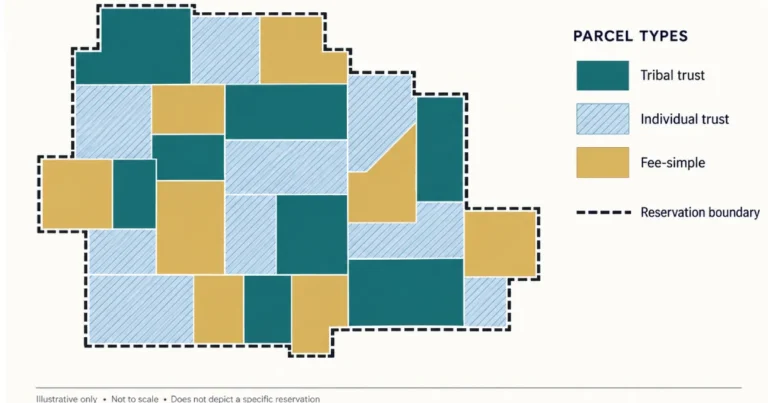
Reservation
- Definition: Land reserved for a Tribal Nation as a permanent homeland, often held in trust by the federal government. Reservations are not the same as the Nation itself—they are part of a Nation’s land base.
Indian Country (Legal Definition)
- Definition: Under 18 U.S.C. §1151, “Indian country” includes reservations, dependent Indian communities, and certain allotments. It defines where federal, Tribal, and sometimes state governments have jurisdiction for criminal and civil matters.
Trust Land vs. Fee Land
- Trust Land:
- Land held in trust by the federal government for a Tribe or individual Native person; the Tribe/individual is the beneficial owner.
- Generally cannot be sold or taxed by state/local governments without federal approval.
- Fee Land:
- Land held in fee simple—full private ownership.
- Can be bought, sold, or taxed like other private property.
Allotment
- Definition: Parcels of land individually assigned to Native people during the Allotment Era (e.g., under the Dawes Act), often leading to massive loss of Tribal land through sales, fractionation, or tax foreclosure.
P.L. 93-638 / “638 Contracts” / Self-Determination Contracts
- Definition: Refers to the Indian Self-Determination and Education Assistance Act of 1975 (Public Law 93-638).
- This law allows Tribal Nations to take over federal programs (like clinics, schools, or policing) through contracts or compacts and run them themselves with federal funding.
- A key tool of self-determination and Tribal control of services.
Public Law 280 (PL 280)
- Definition: A 1953 law that transferred some federal criminal and civil jurisdiction in Indian Country to certain states, often without Tribal consent, creating complex and sometimes contested jurisdictional landscapes.
Sovereign Immunity
- Definition: Legal doctrine that Tribal Nations, like federal and state governments, generally cannot be sued without their consent or explicit waiver, reflecting their status as sovereigns in U.S. law.
UNDRIP – United Nations Declaration on the Rights of Indigenous Peoples
- Definition: A 2007 UN declaration setting minimum standards for the rights of Indigenous peoples worldwide, including self-determination, land rights, culture, and free, prior, and informed consent (FPIC).
Membership & Belonging
Every Nation defines its own community. There is no single, pan-Indian rule.
Enrollment / Citizenship
- Definition: The formal process by which a Tribal Nation recognizes someone as a citizen (or member) with political rights and responsibilities.
- Criteria are set by each Nation and may include lineage, residence, cultural connection, or other factors.
Blood Quantum
- Definition: A fractional measure of “Indian blood” (e.g., ¼, 1/8) historically imposed by the federal government and later adopted by some Tribal Nations as membership criteria.
- Historical context:
- Developed in treaties and federal policy as a way to limit who counted as “Indian”—often with the explicit goal of reducing legal obligations over time.
- Today (2026):
- Some Nations retain blood quantum thresholds (e.g., 1/4, 1/8) to protect limited resources like land, per capita payments, or enrollment size.
- Others see blood quantum as a tool of erasure that can eventually shrink Nations out of existence and are debating or adopting alternatives.
- Painful reality:
- Blood quantum can fuel internal conflict, disenrollment (removal of people from the rolls), and disagreements about who “counts.” For many families, it is a deeply emotional and political issue.
Lineal Descent
- Definition: Membership based on direct descent from an ancestor on a base roll (like an original treaty roll), regardless of “percentage” of blood.
- Many Nations are moving (or considering moving) from blood quantum to lineal descent to ensure future generations remain citizens and to reflect that belonging is about kinship and history, not fractions.
Disenrollment
- Definition: The process by which a Tribal Nation removes a person or family from its citizenship rolls.
- Reasons vary: disputes over lineage, politics, or interpretations of the constitution.
- For many, disenrollment raises hard questions about sovereignty vs. human rights and the long-term impact of policies rooted in colonial definitions of “Indian.”
Clan / Family Systems (Nation-Specific)
- Definition: Many Nations organize identity through clans or extended families, sometimes matrilineal or patrilineal, with specific responsibilities, taboos, and ceremonial roles.
- Clan systems may shape who can marry whom, where one has responsibilities, or how leadership is chosen.
- These systems are highly specific—there is no one clan system for all Nations.
Treaty Rights & Relationships
Treaty
- Definition: A formal agreement between sovereign governments—in this case, Tribal Nations and the United States.
- NCAI emphasizes that treaties recognized Tribal sovereignty and often involved massive land cessions in exchange for ongoing rights and federal obligations.
Treaty Rights
- Definition: Rights that Tribal Nations reserved for themselves in treaties when they ceded vast territories—such as rights to land, water, hunting, fishing, and governance.
- They are part of the “supreme Law of the Land” under the U.S. Constitution.
Usufructuary Rights
- Definition: Use rights—the right to hunt, fish, and gather on lands that may now be owned by others but are part of “ceded territory” in a treaty.
- These rights are often exercised off-reservation and have been repeatedly upheld in courts as continuing obligations of the treaties (for example, in the Great Lakes and Pacific Northwest).
Trust Responsibility (revisited)
- Reaffirmed frequently by NCAI and federal agencies as the U.S. obligation to protect Tribal lands and rights and provide promised services—not as discretionary aid.
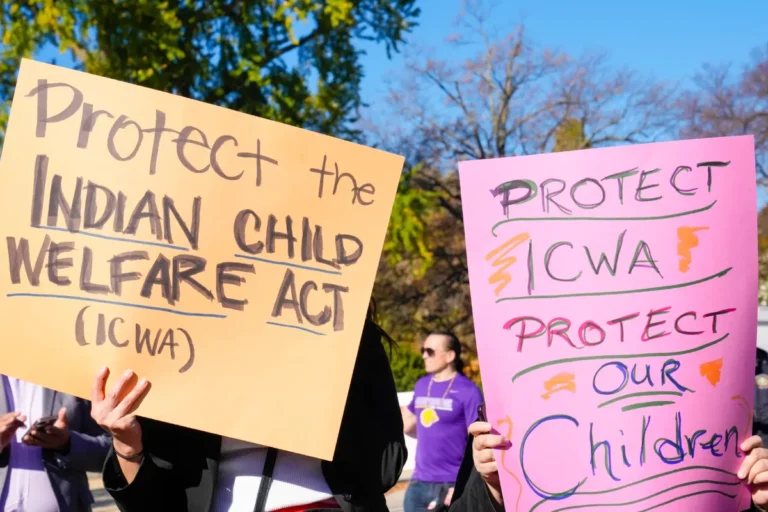
ICWA – Indian Child Welfare Act
- Definition: A 1978 federal law that sets minimum standards for child welfare cases involving “Indian children,” aiming to keep Native children with family and Tribal communities whenever safely possible.
- Passed after studies showed that up to one-third of Native children were being removed and placed in non-Native homes, causing massive cultural loss.
- Widely described by child-welfare organizations as the “gold standard” of child welfare policy.
Modern Cultural & Movement Concepts
Land Acknowledgment
- Definition: A formal statement that recognizes the Indigenous peoples whose homelands one is currently on.
- Educational groups describe land acknowledgments as recognizing the enduring relationship between Indigenous peoples and their territories and as a small first step toward truth-telling.
- 2026 Shift: Native-led organizations urge moving beyond performative scripts toward “Actionable Land Acknowledgments” that may include:
- Supporting Indigenous organizations
- Returning land or co-managing land
- Paying land taxes/honor taxes
- Incorporating Indigenous governance and consent into decisions
Land Back
- Definition: A broad movement focused on returning land, decision-making power, and stewardship to Indigenous peoples.
- Can include full land return, co-management of public lands, long-term leases, conservation easements, and policy changes.
Food Sovereignty
- Definition (general): The right of peoples to define and control their own food systems, prioritizing healthy, culturally appropriate, and sustainable foods.
- Native Food Sovereignty:
- The right of Tribal Nations and Indigenous communities to produce, access, and govern traditional foods—like corn, salmon, wild rice, bison, or country foods—on their lands.
- Considered essential for health, culture, and sovereignty.
Cultural Appropriation vs. Cultural Appreciation
- Cultural Appropriation: When non-Native individuals or businesses use Native designs, regalia, names, or ceremonies without permission, context, or benefit to the community—such as fake “Native” fashion or headdresses at festivals.
- Cultural Appreciation: Involves respect, permission, and reciprocity—buying from Native artists, following protocols, and recognizing intellectual property and sacredness.
Native Mascots / Stereotypes
- Definition: The use of Native imagery or caricatures (e.g., “Indian” mascots) for sports teams or brands.
- Major Native organizations, including NCAI, have long opposed these mascots as harmful stereotypes that dehumanize Native peoples and normalize racism.
Boarding Schools / Residential Schools
- Definition: Institutions in the U.S. and Canada where Indigenous children were forcibly taken from families to be “assimilated,” often facing abuse and cultural suppression.
- Modern reporting and federal investigations frame them as a primary source of historical trauma and intergenerational grief.
MMIW / MMIP – Missing and Murdered Indigenous Women/People
- Definition: A term for the crisis of disproportionately high rates of missing and murdered Indigenous women, girls, and relatives (including men and Two-Spirit people).
- Reflects systemic failures in law enforcement, data collection, and media coverage.
Indigenous Data Sovereignty
- Definition: The principle that Indigenous Nations should own, control, access, and steward data about their peoples, lands, and resources.
- Applies to government datasets, research, health records, and more.
TEK – Traditional Ecological Knowledge
- Definition: Indigenous knowledge systems about land, water, plants, animals, and climate, developed over thousands of years.
- Increasingly recognized in climate, conservation, and land-management policy.
“Two-Eyed Seeing”
- Definition: A concept from Mi’kmaw Elder Albert Marshall describing learning to see with one eye the strengths of Indigenous knowledge and one eye the strengths of Western science, and using both together.
Frequently Asked Questions
Is it okay to say “Indian” in 2025?
It depends. In a legal context (like “Indian Law”), it is correct. Among elders, it is often used. However, for non-Natives speaking to a general audience, “Indigenous” or “Native American” is safer. Never use it as a costume or mascot reference.
What is the difference between a “Reservation” and a “Pueblo” or “Rancheria”?
They are all sovereign lands. “Reservation” is the general term. “Pueblo” refers specifically to the sedentary village-based tribes of the Southwest (New Mexico). “Rancheria” is commonly used for smaller California tribal lands.
Why do some people say they have “Treaty Rights” off the reservation?
Because when tribes signed treaties giving up millions of acres (ceded territory), they often explicitly reserved the right to hunt, fish, and gather on that land forever. These are Usufructuary Rights.
What is a “Federally Recognized Tribe”?
A tribe that has a legal government-to-government relationship with the U.S. (there are 574+ as of 2025). State-recognized tribes exist but do not have the same federal powers or funding.
Conclusion – Language as a Shield and a Bridge
Knowing these terms does more than keep you from making a faux pas. It helps prevent erasure.
- “Sovereignty” is the shield: it names Tribal Nations as governments with inherent rights.
- “Treaty rights” are the contract: they remind everyone that the U.S. still owes legal obligations to Tribal Nations.
In 2026 and beyond, language continues to evolve—especially in digital spaces where Native youth, knowledge keepers, and journalists are reshaping how Indian Country is described.
How to use this glossary:
- Bookmark it as a reference.
- When writing or speaking, prioritize the specific Nation name over generic labels.
- When in doubt, ask people how they identify and follow their lead.