Native American Reservations Explained: Land, Government and Common Myths
The word “reservation” is often used as if it describes one uniform kind of place. In reality, reservations vary enormously in size, history, population, land ownership and government. Some include cities and heavily traveled highways; others are rural or remote. Some retain a large trust-land base, while others have a checkerboard of Tribal, individual and non-Native ownership.
The most important starting point is that a reservation is a Tribal homeland and legal-political geography—not the Tribal Nation itself, not a racial district and not land administered as an ordinary federal park.
What is a federal Indian reservation?
The Bureau of Indian Affairs defines a federal Indian reservation as land reserved for one or more Tribes through a treaty, federal statute, executive order, agreement or administrative action as a permanent homeland. The United States generally holds title to reservation trust land for the benefit of the Tribe.
The BIA counts approximately 326 federally administered Indian land areas, a category that includes reservations, pueblos, rancherias, missions, villages and communities.
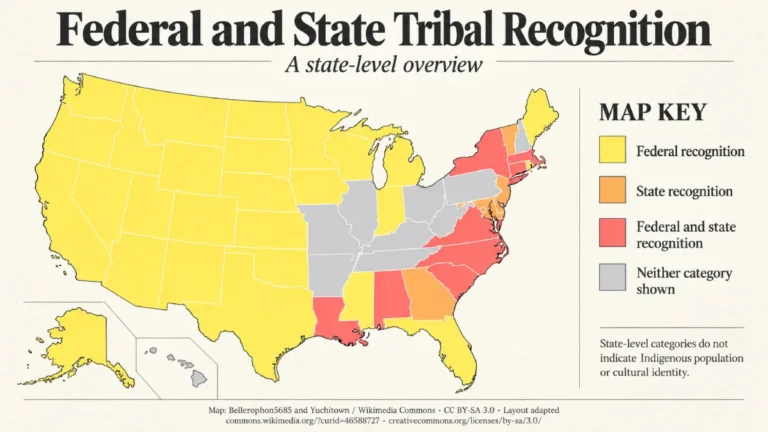
That number is much lower than the 575 Tribal entities on the federal recognition list published January 30, 2026. There is no one-reservation-per-Tribe rule: not every federally recognized Nation has a reservation, some share a land area, and a Nation may have trust land outside its reservation.
A reservation should not be confused with a Tribal Nation. A Nation is a political community with its own citizens and government. Its reservation is all or part of the land base over which it may exercise authority. Tribal citizens can live elsewhere, and living inside a reservation does not automatically make someone a citizen of the governing Nation.
How were reservations created?
Reservation histories are specific to each Nation. Some are surviving portions of ancestral homelands. Others were established after the United States forced Native peoples away from their original territories. The legal instrument may be a treaty, act of Congress, executive order, court decision or administrative action.
The word “reserved” is important. In many treaties, Native Nations ceded large areas while reserving particular lands and rights for themselves. Describing every reservation as land that the United States simply “gave” to a Tribe can therefore reverse the history of the transaction.
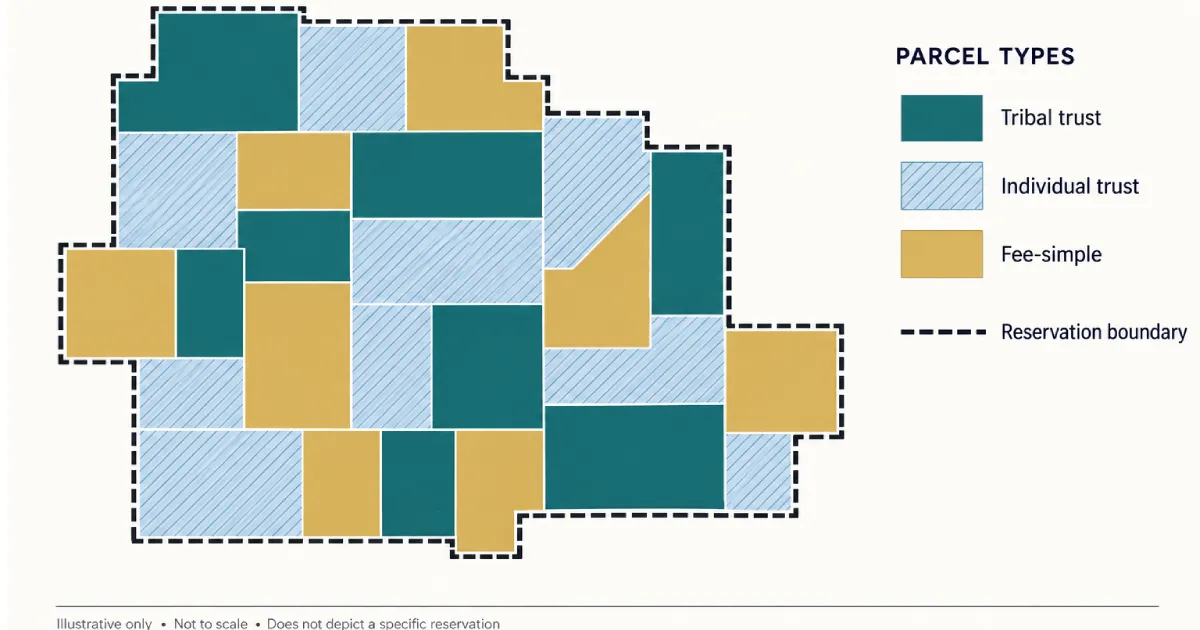
Federal allotment policy later divided many communally held land bases into parcels assigned to individuals. As parcels were sold, inherited or removed from trust, reservations developed mixed ownership. That legacy is often called checkerboarding.
Trust land, restricted land and fee land
A reservation boundary does not reveal who owns every parcel or what legal status it has.
On trust land, the United States holds legal title for the benefit of a Tribal Nation or an individual Native owner. Trust land generally cannot be sold, gifted, leased or mortgaged without federal approval, and it is not subject to state or local property tax. A Tribe may levy its own taxes for governmental services.
Restricted fee land is titled to a Tribe or individual but remains subject to federal restrictions on sale or encumbrance. Fee-simple land is owned outright and can generally be transferred without federal approval. Fee land may be owned by a Tribe, a Tribal citizen or a non-Native person.
Individual trust allotments can become highly fractionated when interests pass to many heirs. The Department of the Interior explains that a single allotment can eventually have hundreds or thousands of owners. Tribes can apply to have eligible fee land taken into trust, but that federal process is separate from buying the property.
Who makes and enforces the law?
Tribal governments are governments, not branches of the BIA. Depending on their laws and institutions, they may operate legislatures, courts, police departments, tax systems, environmental programs, schools, utilities and businesses.
Jurisdiction is nevertheless one of the most complex parts of federal Indian law. “Indian country,” as defined in 18 U.S.C. § 1151, includes reservations, dependent Indian communities and Indian allotments whose titles have not been extinguished.
Which government can investigate, prosecute, regulate or tax may depend on the location, land status, type of activity, identities of the parties, federal statutes, treaties and court decisions.
Tribal, federal and state authorities can all have roles. The U.S. Department of Justice notes that Tribal police and courts handle most criminal offenses occurring in Indian country, but some states exercise congressionally authorized jurisdiction under Public Law 280 and Congress has created rules for particular crimes.
That is why claims such as “state law never applies on a reservation” or “Tribes control everyone and everything inside the boundary” are too broad.
Are reservations closed to the public?
Many reservations contain public-facing roads, homes, schools, shops, offices, casinos, clinics, museums and cultural centers. They are also homelands, not tourist attractions in their entirety.
Access rules vary by Nation and location. Ceremonial grounds, residences, burial places and environmentally sensitive areas may be closed or require permission.
Visitors should consult the Nation’s official website, obey posted rules, ask before photographing people or cultural activity and avoid entering unmarked areas simply because a map shows reservation land.
Reservations are living places where Native Nations govern, provide services, build economies and maintain relationships with their homelands. Their legal arrangements are complicated because U.S. policy made them complicated—not because Tribal sovereignty is imaginary or incomplete.
The most accurate way to understand any reservation is to begin with the Nation that governs it.