Armed Federal Agents Accompany Border-Wall Crews onto Tohono O’odham Nation
Armed federal agents accompanied border-wall contractors onto the Tohono O’odham Nation this week, escalating a dispute over the federal government’s plan to construct 62 miles of barrier along the Nation’s southern boundary.
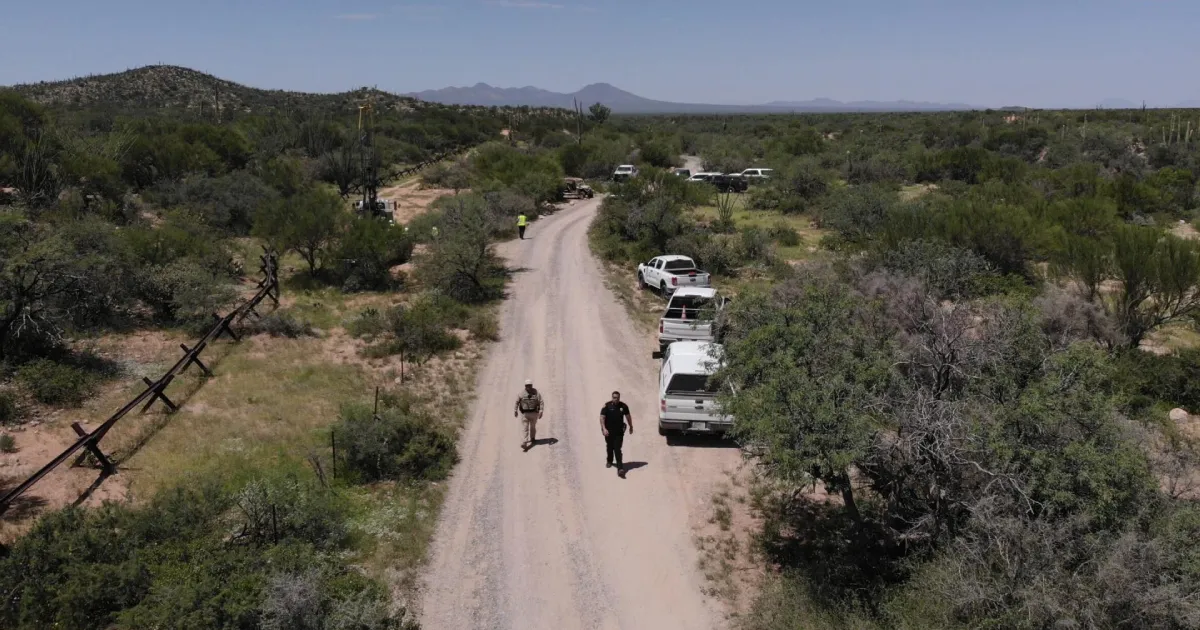
The Tohono O’odham Nation said approximately 20 armed and masked Customs and Border Protection officers entered before dawn on August 25. Contractors brought drill trucks to three locations for soil sampling and other site work.
The Department of Homeland Security also deployed a Border Patrol Tactical Unit, Bureau of Indian Affairs officers and a tethered surveillance balloon, according to the Nation’s account. Mexican law-enforcement personnel were positioned south of the international boundary.
A vehicle blockade prevented Tohono O’odham police from removing or citing the contractors, the Nation said. Interactions between the different police agencies remained peaceful and professional, and no physical confrontations were reported.
Local public-media outlet AZPM documented the Nation’s account of the federal deployment. Drone video subsequently reviewed by The Associated Press showed approximately 14 vehicles and an industrial drill at one work site.
Contractors had previously been turned away
Tohono O’odham Nation Chairman Verlon M. Jose said Tribal authorities had escorted approximately seven contractors from Nation land during the preceding weeks.
The Nation posted “No Trespassing” signs and warned that contractors who entered without authorization could be removed or cited under Tribal law.
On August 24, Jose publicly urged the administration to abandon the project. Federal agents and contractors entered the following morning.
The Nation argues that even if the wall itself is placed within the 60-foot-wide federal corridor known as the Roosevelt Reservation, contractors cannot lawfully cross or use adjacent Nation land without permission.
That distinction is central to the current confrontation. The federal government claims authority over the narrow Roosevelt Reservation established by a 1907 presidential proclamation. The Tohono O’odham Nation disputes the corridor’s legal application to land subject to its aboriginal title and separately maintains that roads, equipment, staging areas and construction access cannot be placed on Nation land without consent.
Customs and Border Protection Commissioner Rodney Scott defended the project, describing the region as a dangerous corridor used for trafficking and smuggling. CBP has not publicly provided a detailed response to each of the Nation’s jurisdictional allegations.
Injunction denial did not authorize unrestricted access
Senior U.S. District Judge Richard Leon denied the Nation’s request for a preliminary injunction on August 14. He found that the Nation had not yet shown it was likely to prevail on its boundary and trespass claims.
The ruling was not a final judgment dismissing the lawsuit. Nor did it grant contractors unlimited authority to operate throughout the reservation.
Leon’s memorandum opinion relied partly on federal representations that the project would remain within the 60-foot Roosevelt Reservation. The judge noted that the government had not articulated plans to build outside that corridor.
The new activity therefore creates a factual question not fully resolved by the injunction ruling: whether the contractors reached and worked at the three locations without entering Nation land outside the federal strip.
Tribal officials said they were consulting attorneys about further filings and options for removing unauthorized personnel.
Site work begins earlier than anticipated
During the injunction proceedings, CBP told the court that construction was not expected to begin before October 12.
The August 25 activity should be described carefully. Contractors conducted soil sampling and other preparatory work; available reporting does not establish that permanent steel bollards had already been installed.
Nevertheless, the presence of industrial drilling equipment and federal tactical personnel shows that physical implementation is underway weeks before the date previously associated with principal construction.
SLSCO Ltd., the Texas contractor leading the Arizona work, has received more than $390 million in Department of Homeland Security funding for border-wall projects since 2023, according to federal spending records.
Sovereignty and sacred places remain at issue
The Tohono O’odham Nation has approximately 37,000 citizens, including O’odham communities in Mexico. Families, ceremonial responsibilities and culturally significant places span the international boundary.
Nation leaders warn that a permanent wall will interfere with movement, fragment wildlife habitat and endanger burial places, archaeological resources and landscapes central to O’odham religious life.
Those concerns are informed by documented damage from earlier border work. In April, a federal contractor damaged part of Las Playas Intaglio, an ancient earthwork shaped like a fish. The Nation maintains a record of the damage and its continuing opposition on its official border-wall information page.
The immediate dispute is therefore about more than where the steel barrier will stand. It concerns whether the federal government may use armed personnel to overcome the Nation’s enforcement of its own laws while the legal boundaries of federal authority remain contested.
No violence occurred during the August 25 operation. But the deployment has sharply increased the risk of confrontation and made the next court filing more urgent.
The Nation’s lawsuit continues. Its next legal action may determine whether the government must address access and staging separately from its claimed authority to build within the Roosevelt Reservation.