Federally Recognized vs. State-Recognized Tribes: What the Difference Means
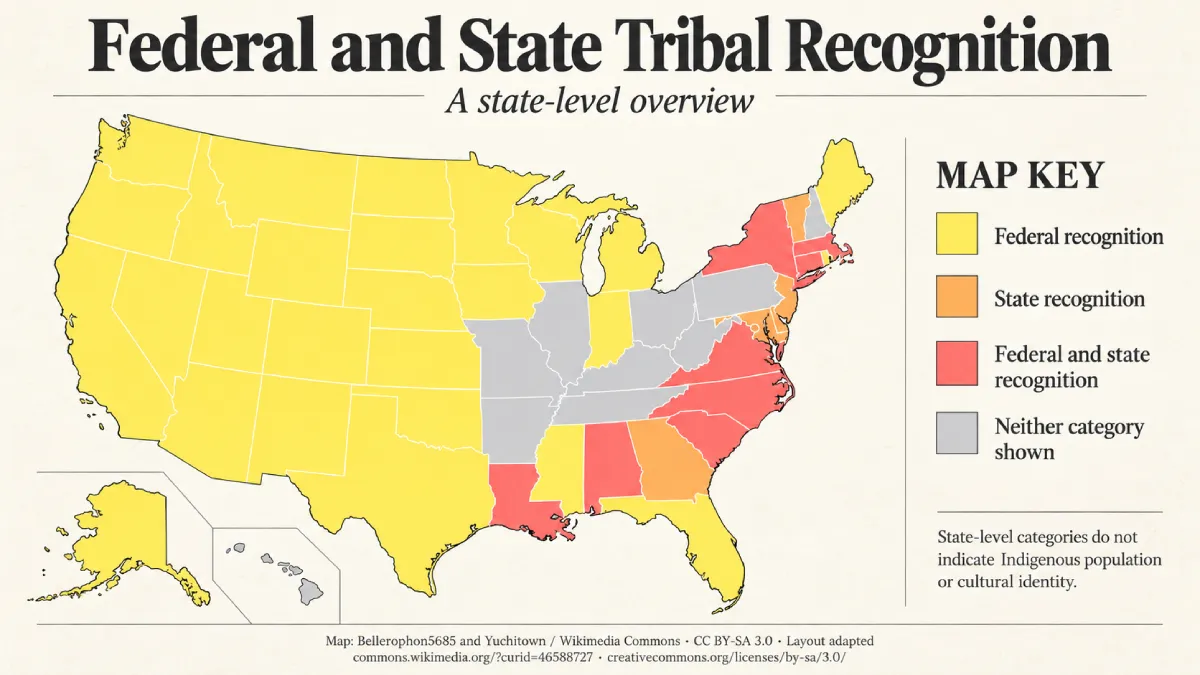
Federal recognition establishes a government-to-government relationship between a Tribal Nation and the United States. State recognition is acknowledgment by an individual state under its own laws or official procedures. A Nation can have both, but state recognition alone does not confer federal recognition or its full legal consequences.
The distinction matters when discussing government authority, services, land and eligibility under particular laws. It also needs to be kept separate from ancestry and Tribal citizenship: recognition concerns a political entity, while citizenship concerns an individual’s relationship with that Nation.
Federal vs. state recognition at a glance
| Question | Federal recognition | State recognition alone |
|---|---|---|
| Government involved | The United States. | An individual state. |
| Legal framework | Federal statutes, acknowledgment regulations and relevant judicial decisions. | The particular state’s laws, procedures and recognition history. |
| Federal relationship | Recognizes a government-to-government relationship with federal responsibilities and certain inherent self-governing powers. | Does not, by itself, establish that federal relationship. |
| Programs and services | Provides a basis for BIA eligibility; each program still has its own requirements. | State opportunities vary. Some federal laws or programs expressly include state-recognized Tribes. |
| Citizenship | The Nation’s citizenship or enrollment rules apply. | The community’s own rules apply; state recognition does not enroll an individual in a federally recognized Nation. |
The comparison draws on the BIA’s definition of federal recognition and the state processes discussed below. “State recognition alone” means the Nation does not also hold federal recognition.
What federal recognition means
The Bureau of Indian Affairs defines a federally recognized Tribe as an American Indian or Alaska Native Tribal entity with a government-to-government relationship with the United States. That relationship carries responsibilities, powers, protections and limitations under federal law.
Recognition acknowledges certain inherent powers of self-government. Describing sovereignty as something the federal government simply gives to Tribes overlooks the existence of Native Nations before the United States. The BIA’s explanation of Tribal legal status describes these retained powers.
Federal recognition also supports eligibility for BIA funding and services and the application of federal Indian laws. It does not mean that all Nations have identical jurisdiction, land holdings or access to every program. Treaties, statutes, court decisions, land status and program rules remain important.
How many federally recognized Tribes are there?
The Department of the Interior’s January 30, 2026 list contains 575 federally recognized Tribal entities. The BIA’s Tribal Leaders Directory also reports 575. These sources were checked on October 4, 2026.
The official list includes Nations, Tribes, bands, pueblos, rancherias, communities and Alaska Native villages. Its count is a count of listed political entities, not a count of individual Native people or every Indigenous community in the country.
A recent example: the Lumbee Tribe of North Carolina
The Lumbee Tribe’s official recognition page records full federal recognition on December 18, 2025, through legislation. Interior added the Tribe to the published list on January 30, 2026. Older guides that describe the Lumbee only as state-recognized need updating.
The federal notice also identifies conditions and timing for services, including verification of the Tribal roll and assessment of service needs. Recognition and the delivery of every federal service do not necessarily begin together.
How federal recognition is established
Many recognized relationships developed through treaties, legislation, executive orders or earlier federal actions. The BIA identifies three principal routes to federal recognition: an act of Congress, the administrative acknowledgment process and a decision of a United States court. Judicial recognition depends on the particular legal case; it is not a routine application process.
The Office of Federal Acknowledgment, within the Office of the Assistant Secretary—Indian Affairs, administers the process under 25 CFR Part 83. “Acknowledgment” is the term used for this administrative route.
The criteria in 25 CFR § 83.11 address seven subjects:
- Identification as an American Indian entity on a substantially continuous basis since 1900.
- A distinct community existing from 1900 to the present.
- Political influence or authority maintained from 1900 to the present.
- A governing document, or a statement of governing procedures and membership criteria.
- Descent from a historical Indian Tribe or historically combined Tribes functioning as one autonomous political entity.
- Membership composed principally of people who are not members of a federally recognized Tribe, subject to the regulation’s qualifications.
- The absence of congressional legislation expressly terminating or forbidding the federal relationship.
This is a summary; the regulation explains evidence, qualifications and how the criteria operate. State recognition may be relevant evidence, but it does not replace the federal requirements. The process examines a community’s political and historical continuity, rather than a DNA ethnicity estimate. Congress can also recognize a Nation through legislation outside this administrative process.
What state recognition means—and why it varies
There is no uniform national state-recognition procedure. The responsible authority, evidence required and legal consequences depend on the state. Some states have formal processes; others do not.
Virginia’s Secretary of the Commonwealth describes state recognition as a formal declaration by the Commonwealth. Its account identifies recognition through legislation and treaty history. North Carolina’s Tribal Recognition Program assists its Commission of Indian Affairs and Recognition Committee with documented petitions under North Carolina’s own framework.
These are different state systems. A state may provide a role in a commission, cultural initiatives or eligibility for specified programs, but those consequences must be checked individually. Recognition by one state does not establish a uniform set of rights across the country.
Can a Tribe be federally and state-recognized?
Yes. The Pamunkey Indian Tribe appears on the federal list and Virginia includes the Pamunkey on its state-recognized Tribal page. The labels describe relationships with different governments and can overlap.
Similarly, state recognition does not automatically lead to federal recognition. A pending federal petition is also distinct from an approved acknowledgment decision. When reporting status, identify the government and the action that actually took effect.
What recognition means for services, land and gaming
Services depend on the specific program
State recognition alone does not establish general eligibility for BIA services on the basis of federally recognized Tribal status. Equally, membership in a federally recognized Nation is not a guarantee of every benefit. A program may have additional requirements concerning residence, income, age or other circumstances.
Ask which law or program is involved, whether eligibility applies to the Nation or an individual, and what documentation the administering office requires. A broad statement that someone “qualifies for Native benefits” is too imprecise to be useful.
Recognition and land status are separate questions
Recognition does not automatically turn all land owned by a Nation or its citizens into federal trust land. The BIA describes fee-to-trust acquisition as a separate process for placing land into federal trust. State recognition alone does not accomplish that transfer.
Likewise, the presence or absence of a reservation is not a reliable shortcut for determining federal recognition. Verify the Nation’s status and the particular parcel’s legal status separately before drawing conclusions about jurisdiction.
Recognition alone does not authorize a casino
The Indian Gaming Regulatory Act (IGRA) uses its own definitions of “Indian tribe” and “Indian lands”. State recognition alone does not satisfy the Act’s federal-recognition requirement. Gaming also depends on eligible land and the applicable regulatory requirements.
The National Indian Gaming Commission’s overview distinguishes gaming classes and explains the role of Tribal-state compacts for Class III gaming. Federal recognition is therefore one part of the legal framework, not automatic permission to open a casino.
Some federal laws expressly include state-recognized Tribes
The Indian Arts and Crafts Act provides a useful example. This truth-in-advertising law prohibits misleading marketing of Indian arts and crafts. For its purposes, the definition includes members of federally recognized or officially state-recognized Tribes, as well as individuals certified as Indian artisans by a qualifying Tribe.
That statutory inclusion does not confer federal recognition. It demonstrates why the definition in the particular law matters. Sellers must also describe an artist’s Tribal affiliation accurately; a qualifying status does not make every marketing claim permissible.
Recognition, citizenship and ancestry answer different questions
Keep these terms distinct:
- Recognition: What legal relationship does a Tribal entity have with the federal government or a state?
- Tribal citizenship or membership: Does the relevant Nation recognize the person under its own rules?
- Ancestry: What family relationships can the evidence establish?
- Self-identification: How does the person describe their identity? That statement alone does not establish citizenship or legal eligibility.
The Department of the Interior’s enrollment guidance explains that membership requirements differ among Tribes and directs applicants to the Tribe itself. A DNA result, family story or citizenship document from a different organization does not substitute for the relevant Nation’s determination.
Federal recognition has substantial legal consequences, but it is not a complete measure of a community’s history or cultural life. Displacement, discriminatory records and federal termination policies have shaped recognition histories. Communities without federal recognition should be described through documented histories and their particular circumstances.
Respectful reporting still requires scrutiny. Neither dismiss every unrecognized community nor accept every claimed affiliation without evidence. Attribute disputed claims, consult the Nations involved and distinguish historical relationships from present legal status.
How to verify a Tribe’s recognition status
- Check the federal list. Search the latest Interior notice, including any name-change references. For a very recent recognition, check the law or final action and its effective date as well.
- Identify the state authority. Consult the responsible state office, recognition commission or enacted legislation. A general heritage proclamation or nonprofit registration should not be assumed to establish Tribal recognition.
- Confirm the exact entity. Similar names can refer to different organizations. Match the official name, location and government website.
- Read the Nation’s own account. Use its preferred name and terminology, and distinguish citizenship information from recognition history.
- Verify the practical consequence. Check the specific statute, program or land record before making a claim about benefits, gaming or jurisdiction.
For accurate reporting, name the recognizing government, the relevant legal action and the date. That approach explains what recognition provides while keeping citizenship, ancestry and cultural history in their proper context.
Sources checked October 4, 2026. Recognition decisions and program rules can change; the linked government and Tribal sources provide the basis for this guide.