Cherokee Nation Opens $30M Immersion School in Tahlequah
The Cherokee Nation dedicated a $30 million, purpose-built Cherokee-language immersion middle school on August 17, 2026, marking a major expansion of its effort to create new generations of Cherokee speakers.
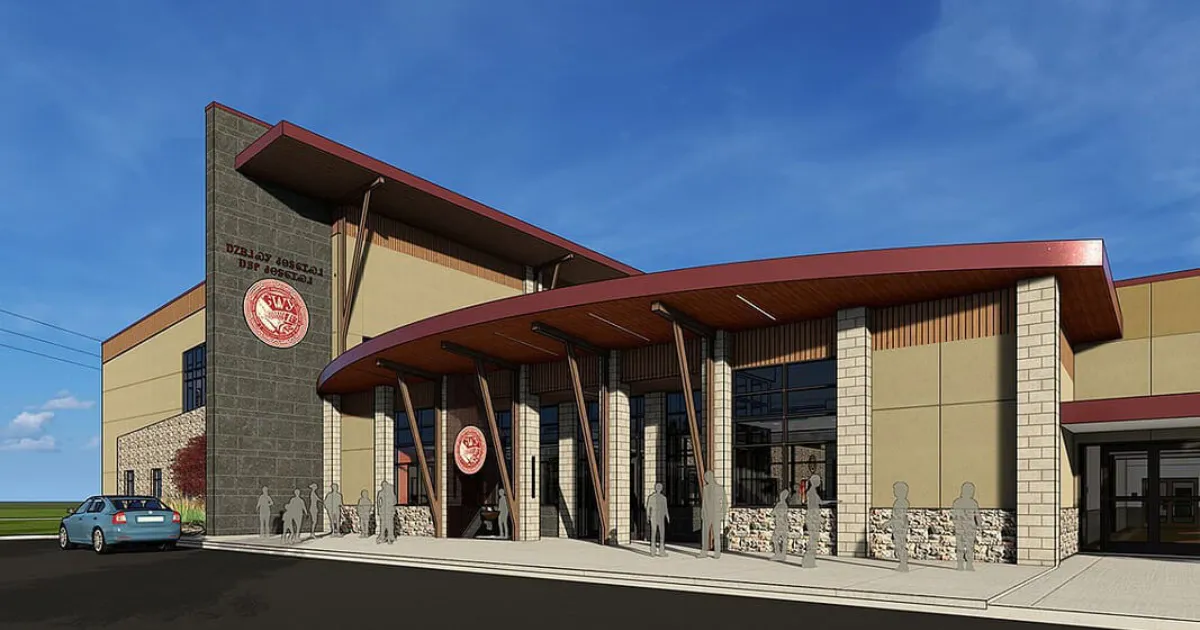
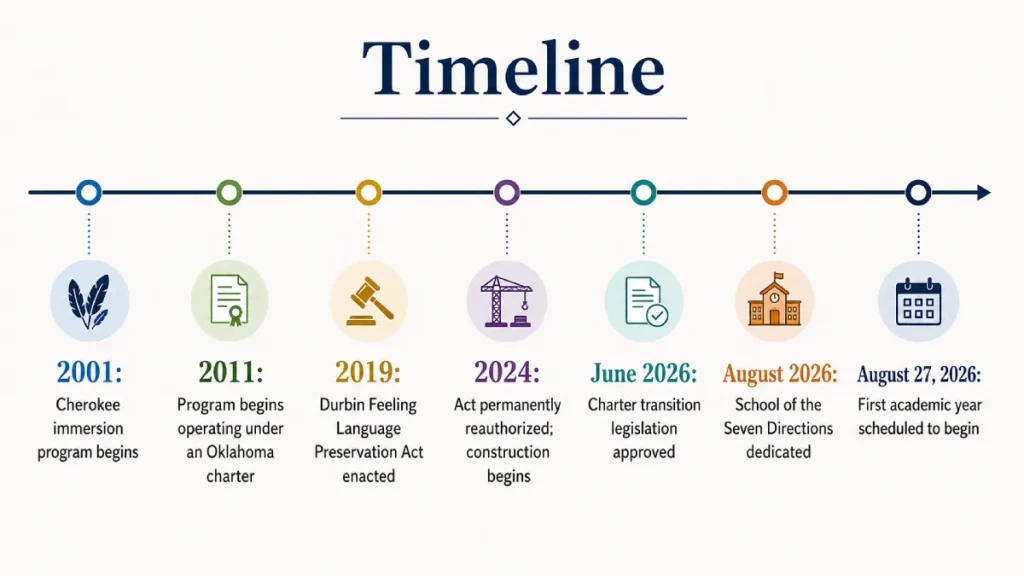
The more than 66,000-square-foot School of the Seven Directions is scheduled to begin classes on August 27. Its 16 classrooms will serve students in fourth through eighth grades, allowing them to study mathematics, science, arts, culture and everyday life through the Cherokee language.
The new building stands beside the Durbin Feeling Language Center in Tahlequah, forming a larger language campus that brings together children’s immersion education, adult language learning, curriculum development and work with first-language speakers.
Quick facts: School of the Seven Directions
- Cherokee name: ᏧᎾᏕᎶᏆᏍᏗ ᎦᎵᏉᎩ ᏂᏚᏳᎪᏛ, rendered in English as “School of the Seven Directions.”
- Location: 16345 Highway 62 in Tahlequah, Oklahoma, adjacent to the Durbin Feeling Language Center.
- Project: Approximately $30 million and more than 66,000 square feet, with 16 classrooms.
- Grades: Fourth through eighth grade; younger immersion students remain at the Durbin Feeling Language Center.
- Instruction: Cherokee Nation says classroom instruction, signs and spoken communication inside the school will be in Cherokee.
- Calendar: A year-round structure retaining 180 instructional days and intended to reduce language loss during long school breaks.
- Governance: Operated independently by the Cherokee Nation following the expiration of its Oklahoma public-school charter on June 30, 2026.
A Purpose-Built Cherokee Immersion Middle School
The opening gives Cherokee immersion students a dedicated place to continue their education through eighth grade.
Fourth- through eighth-grade students will move into the School of the Seven Directions, while prekindergarten through third-grade learners will remain at the Durbin Feeling Language Center. Separating the age groups also gives the Nation additional room to expand its early-childhood and elementary immersion programs.
At the dedication, Principal Chief Chuck Hoskin Jr. called the opening a turning point, saying, “The dawn of a new age has begun for Cherokee language immersion.”
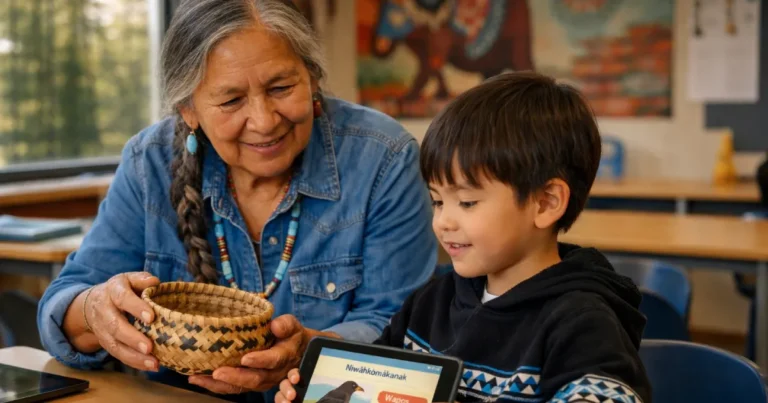
The school’s purpose goes beyond offering Cherokee as one subject within an otherwise English-language curriculum. Immersion students learn academic content and participate in ordinary school routines through Cherokee, helping the language function as a practical means of communication rather than only an object of study.
That distinction is important. Classroom lessons can teach vocabulary and grammar, but immersion creates repeated opportunities for children to use the language when solving problems, playing sports, eating lunch, working on projects and speaking with classmates.
Architectural Design Integrates Cherokee Traditions and the Equinoxes
The campus was designed around Cherokee cultural practice rather than constructed as a conventional school with cultural elements added later.
A central courtyard is aligned with the spring and fall equinoxes. It includes a fire hearth, stickball pole and other ceremonial features positioned in relation to seasonal sunlight. The design also incorporates references to the seven Cherokee clans and the four cardinal directions.
Executive Director of the Cherokee Language Department Howard Paden summarized the design philosophy during the opening: “Everything that you see here was done on purpose.”
The campus includes:
- A stickball field and gymnasium
- A media center and cafeteria
- Science and technology classrooms
- Music, dance and pottery spaces
- A covered art patio
- Wrestling and life-skills facilities
- Areas for flint knapping, bow-making and woodcarving
These are not merely extracurricular additions. They allow students to encounter Cherokee terminology in physical activity, art, land-based learning, traditional technologies and contemporary academic subjects.
Cherokee Nation also says signs throughout the school are written in Cherokee and that Cherokee will be the language spoken inside the facility.
Why Approximately 1,500 First-Language Cherokee Speakers Remain
Recent Cherokee Nation estimates place the number of first-language Cherokee speakers at approximately 1,500. The Nation has also identified several thousand second-language learners with varying levels of conversational ability and proficiency. Because speaker counts depend on changing proficiency definitions and continuing assessments, they should be treated as estimates rather than fixed totals.
Many first-language speakers are elders, which creates an urgent need to transfer vocabulary, pronunciation, oral history and conversational knowledge while those speakers can still work directly with learners.
The decline did not happen naturally. Cherokee Nation leaders connect today’s language emergency to removal, land dispossession, federal boarding schools, English-only education and other government policies that discouraged or punished Native language use.
Immersion education is one attempt to reverse that interruption. Instead of asking children to memorize isolated word lists, it creates an environment in which Cherokee is used to understand academic subjects, build friendships, express humor and complete ordinary daily tasks.
As explained in our guide to Indigenous language revitalization strategies, successful revitalization normally requires an ecosystem of schools, families, elder speakers, adult learners, documentation, digital resources and community spaces—not one program working in isolation.
The Durbin Feeling Act and More Than $182 Million in Language Investment
The school is one component of a much broader language strategy established through the Durbin Feeling Language Preservation Act.
The Cherokee Nation enacted the original law in 2019, permanently reauthorized it in 2024 and amended it again in 2026 as the immersion program moved away from Oklahoma charter-school governance.
As of August 21, 2026, Cherokee Nation reported committing more than $182 million to language preservation since the law was adopted. Its 2026 operating investment in the Language Department exceeded $28 million.
The law establishes a minimum annual operating allocation of $18 million for the Nation’s overall language programs. That floor supports more than the new middle school and may include:
- Children’s immersion education
- Adult master-apprentice programs
- Translation and curriculum development
- Language technology
- Community outreach
- Services for first-language speakers
- Housing and cultural-campus initiatives
The amended law also authorized $35 million in capital spending. That includes up to $30 million for the School of the Seven Directions, improvements at the Greasy immersion campus and protection of more than 1,400 acres near Kenwood for a future language and culture campus.
Who was Durbin Feeling?
Durbin Feeling, who lived from 1946 to 2020, was one of the most influential Cherokee linguists of the modern era. His work included the Cherokee–English Dictionary, grammatical documentation, instructional resources and efforts to make the Cherokee syllabary usable through modern digital technology. Cherokee Nation recognizes his work as foundational to present-day language teaching and revitalization.
Naming the preservation law and neighboring language center for Feeling connects the new school to decades of language documentation and teaching rather than presenting revitalization as a newly created initiative.
From Oklahoma Charter Status to Cherokee Nation Governance
The School of the Seven Directions is opening during a significant governance transition.
Cherokee Nation began its immersion program in 2001. Beginning in 2011, it operated under an Oklahoma public-school charter, giving the program access to state and federal education funding but also placing it within state curriculum, testing, auditing and administrative systems developed largely for English-language schools.
Following an internal review, the Principal Chief decided not to renew the charter when it expired on June 30, 2026. Amendments signed on June 25 prepared the immersion program to operate under Cherokee Nation authority beginning July 1.
The decision gives the Nation greater control over:
- Language-based curriculum design
- Measures of student fluency and academic progress
- Land-based and culturally grounded instruction
- Teacher qualifications and professional development
- The role of first-language speakers
- School calendars and program evaluation
It also carries a financial cost. Cherokee Nation estimated that leaving the charter system would require it to replace approximately $2.5 million to $4 million in annual state and federal funds associated with charter status.
The amended law requires a Cherokee Nation Immersion Education Advisory Board to be established by December 31, 2026. The board may have up to five members, including at least two fluent Cherokee speakers and at least two people with substantial teaching or school-administration experience.
The program has also received provisional accreditation through the World Indigenous Nations Higher Education Consortium, commonly known as WINHEC. WINHEC evaluates Indigenous education through standards created with Indigenous institutions and communities rather than relying exclusively on conventional state systems.
Hoskin described the governance change directly: “This amendment declares our independence.”
A Year-Round Calendar Designed to Support Language Continuity
The 2026–27 academic year will also introduce a year-round calendar.
The calendar retains 180 instructional days but distributes breaks differently from a conventional school schedule. Cherokee Nation says the change is intended to reduce the loss of language proficiency that can occur when students spend an extended summer away from an immersive environment.
The program is also implementing a land-based curriculum that connects classroom instruction with Cherokee relationships to place, seasons, plants, animals, community responsibilities and cultural practice.
A year-round structure cannot guarantee that students will continue using Cherokee outside school. It can, however, reduce long interruptions and create more consistent contact with teachers, classmates and fluent speakers.
Buildings Alone Cannot Create New Speakers
The School of the Seven Directions removes an important physical constraint, but the future of Cherokee will not be determined by construction alone.
Writing several days after the dedication, Hoskin cautioned that “buildings and budgets alone cannot save a language — people do.”
Long-term progress will depend on whether Cherokee Nation can:
- Recruit, train and retain immersion teachers
- Expand subject-specific vocabulary and curriculum
- Support first-language speakers as teachers and mentors
- Help parents use Cherokee in the home
- Give students opportunities to speak beyond school
- Develop pathways for graduates to become teachers, translators and community leaders
- Measure sustained conversational use rather than enrollment alone
The 2026 law requires continuing evaluation of language learning, academic progress, staffing, budgets, student well-being and college or career preparation. Those reports will be important for determining whether increased investment is producing more confident, lifelong speakers.
The new school nevertheless represents a substantial change in what is possible. Cherokee children can now continue immersion through eighth grade in a facility expressly designed for their language, culture and Nation.
At a time when the number of first-language speakers continues to decline, the School of the Seven Directions is an investment not simply in preserving records of Cherokee, but in creating people who can carry the language into homes, professions, public institutions and future generations.
Frequently Asked Questions
What is the Cherokee name of the School of the Seven Directions?
Cherokee Nation gives the school’s name as ᏧᎾᏕᎶᏆᏍᏗ ᎦᎵᏉᎩ ᏂᏚᏳᎪᏛ, with “School of the Seven Directions” as its English rendering.
Where is the Cherokee immersion school located?
The school is located at 16345 Highway 62 in Tahlequah, Oklahoma, beside the Durbin Feeling Language Center. Together, the facilities form a larger campus for children’s immersion, adult language education and work with first-language speakers.
What grades does the School of the Seven Directions serve?
The 16-classroom school serves students in fourth through eighth grades. Prekindergarten through third-grade immersion students remain at the nearby Durbin Feeling Language Center.
Why did Cherokee Nation leave the Oklahoma charter-school system?
The charter arrangement provided public funding but also subjected the immersion program to Oklahoma curriculum, assessment and administrative requirements. Following an internal review, Cherokee Nation chose to replace the expiring charter with direct Tribal governance, independent accreditation and evaluation standards designed for its language mission. The Nation expects to replace approximately $2.5 million to $4 million in charter-related annual funding.
How many first-language Cherokee speakers remain?
Recent Cherokee Nation materials estimate that approximately 1,500 first-language speakers remain. The number is an estimate and can change according to deaths, new assessments and the criteria used to distinguish first-language, fluent and conversational speakers.
Who was Durbin Feeling?
Durbin Feeling was a Cherokee linguist, educator and author whose dictionary, grammar and digital-language work helped make Cherokee more accessible to students, teachers and technology users. The Cherokee Nation’s principal language-preservation law and its Tahlequah language center are named in his honor.