Battle of the Little Bighorn (1876)
How Lakota, Cheyenne & Arapaho Warriors Carried the Day
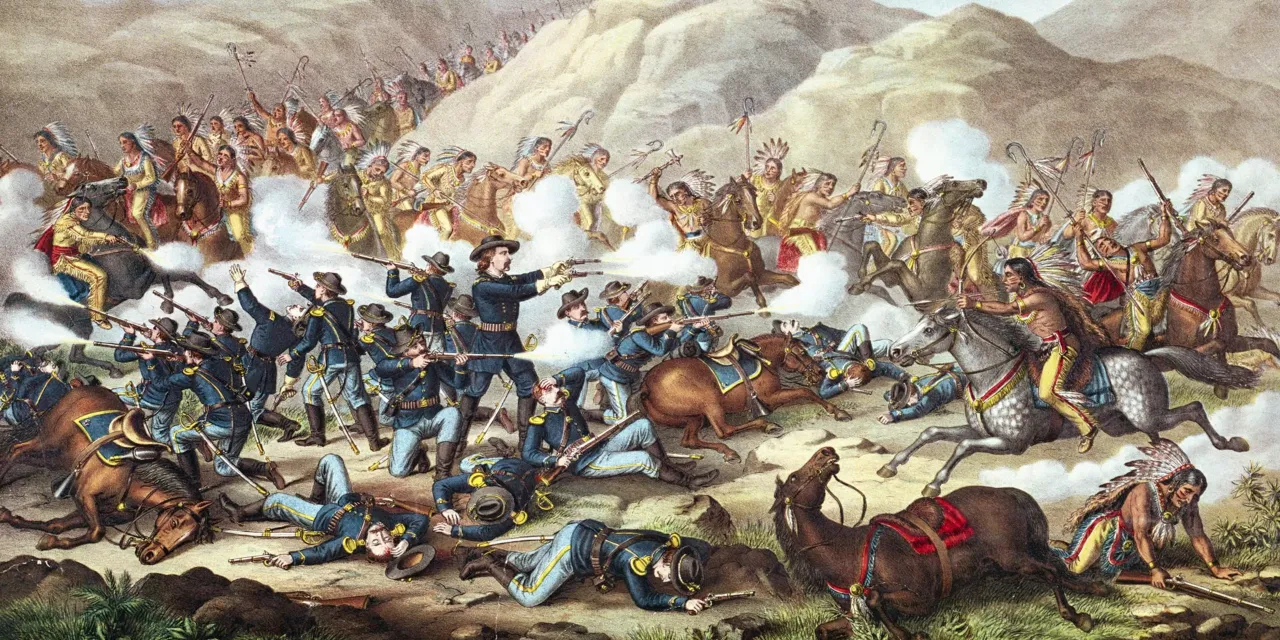
On 25 June 1876—when the United States was preparing its Centennial celebrations—Lieutenant Colonel George Armstrong Custer led five companies of the 7th Cavalry into a valley the Lakota call Greasy Grass. By sunset the next day nearly every soldier under his immediate command lay dead, and the Plains Nations had scored the most decisive Native victory of the Indian Wars.
Sparks of Conflict
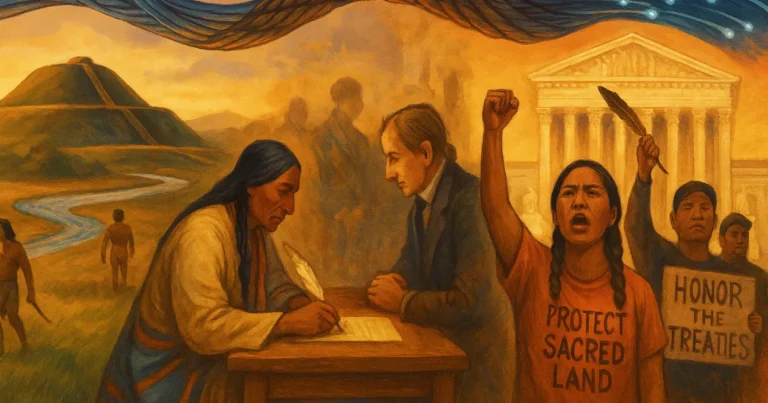
- 1868 Fort Laramie Treaty guaranteed the Black Hills to the Lakota.
- 1874 Custer’s Black Hills expedition confirmed gold and triggered a rush that the U.S. failed to halt.
- January 1876 ultimatum ordered “hostile” bands to agency reservations; thousands instead followed Sitting Bull (Hunkpapa) and Crazy Horse (Oglala) onto traditional hunting grounds.
By early summer, scouts counted 7,000–8,000 people—including 1,500–2,000 warriors—camped along the Little Bighorn River.
Native Strategy & Leadership
| Leader | Role in Battle | Notable Actions |
|---|---|---|
| Sitting Bull(Hunkpapa) | Spiritual & diplomatic head | Held a Sun Dance in mid-June; vision of “soldiers falling like grasshoppers” boosted morale. |
| Crazy Horse (Oglala) | Tactical field leader | Led a flanking charge that shattered Reno’s initial attack, then wheeled toward Custer’s wing. |
| Gall (Hunkpapa) | Battlefield coordinator | Interpreted U.S. movements; urged warriors to cross the river and strike Custer head-on. |
| Two Moons (Northern Cheyenne) | Cheyenne commander | Drove cavalry from bluffs; later provided detailed oral account. |
Key Advantages
- Numbers & cohesion – Custer faced as many as 9 warriors per trooper.
- Superior field intelligence – Young scouts watched cavalry columns for days, giving leaders real-time estimates of enemy size.
- Repeating rifles & traditional weapons – Many warriors carried lever-action Henrys or Spencers, firing 7-13 rounds before reloading, out-pacing the cavalry’s single-shot Springfields that jammed after rapid fire.
- Mobility – Warriors fought on fresh ponies; Custer’s horses were worn from a forced march.
How the Battle Unfolded
| Time (June 25) | Event |
|---|---|
| ~3:00 p.m. | Custer splits his regiment: Major Reno to attack the south end, Captain Benteen to scout south ridges, Custer rides north for a “decisive strike.” |
| 3:30–4:15 | Reno’s charge stalls in tall timber; Crazy Horse’s counter-attack forces Reno across the river in disarray. |
| 4:20–4:40 | Warriors pivot toward Custer. Gall’s and Two Moons’ fighters cut off any crossing back to the river. |
| 4:45–5:30 | Encirclement on “Last Stand Hill.” Rapid-fire Henry and Spencer rifles, plus volleys of arrows and couched lances, overrun five companies in about 20 minutes. None of Custer’s 210 men survive. |
| Evening 25–26 June | Warriors besiege Reno and Benteen on the bluffs but withdraw next day as U.S. reinforcements approach. |
Aftermath & Legacy
- Psychological shock — The U.S. press called it “Custer’s Last Stand,” but Lakota and Cheyenne remembered it as a defense of sovereignty.
- Federal backlash — Within months the Army surged 2,500 troops into the Powder River; by 1877 Crazy Horse surrendered and was killed at Fort Robinson.
- Lakota title fight — The Black Hills were seized without compensation, a taking the U.S. Supreme Court deemed unlawful in 1980.
- Cultural memory — For Native Nations, Little Bighorn endures as proof that coordinated resistance could defeat a technologically advanced foe on its own terms.
Frequently Asked Questions
Did Custer really refuse Gatling guns?
Yes. He left them at Fort Abraham Lincoln fearing they’d slow his column, forfeiting the regiment’s only rapid-fire weapons.
Were women present in the fighting?
Yes. Cheyenne accounts note Buffalo Calf Road Woman rescuing her brother and possibly knocking Custer from his horse early in the fight.
How many Native warriors were killed?
Estimates range 31–50 —far fewer than the 268 soldiers and scouts killed—but exact numbers are uncertain because many families removed their dead for private burial.
Why did some Crow and Arikara scouts fight with Custer?
They were long-time enemies of the Lakota and sought to protect their own homelands from Sioux expansion.
Is the site preserved today?
Yes. The Little Bighorn Battlefield National Monument in Montana includes soldier and warrior memorials and a 4.5-mile tour road following battle positions.
Key Takeaways
- Native victory owed as much to strategic vision—camp consolidation, superior scouting, swift massing of force—as to Custer’s miscalculations.
- Though U.S. retaliation proved overwhelming, the battle stands as a watershed assertion of Plains sovereignty and a cautionary tale about underestimating Indigenous resistance.
Were you surprised by the tactics that turned the tide at Little Bighorn? Share your thoughts or any family stories tied to this pivotal moment in the comments below—let’s keep the history alive.