A Living Timeline of Native Nations
Updated quarterly—last revised July 2025
Indigenous histories span millennia, 574+ federally recognized tribes, and hundreds of sovereign nations still thriving today. This living timeline highlights watershed moments while linking out to deeper nation-specific stories, maps, oral histories, and primary documents. Use the jump links below to explore, or scroll chronologically.
Jump to era:
Pre-Contact | Colonial Contact & Early Resistance | Removal & Treaty | Allotment & Assimilation | Reorganization & WWII | Red Power & Self-Determination | Sovereignty & Cultural Revival | Contemporary Era
Pre-Contact Networks (Before 1492)
Snapshot – Complex trade routes linked Mississippian metropolis Cahokia, Aztec Tenochtitlan, and Arctic whaling cultures long before European arrival. Agricultural innovations—“Three Sisters” intercropping of corn, beans, squash—supported city-states of 30k+ residents.
Key markers
- c. 900 CE – Cahokia’s Monks Mound constructed; population rivals medieval London.
- c. 1000 CE – Norse land at L’Anse aux Meadows, exchanging goods with Beothuk.
- c. 1450 CE – Abandonment of Chaco Canyon great houses signals drought-driven migrations across the Southwest.
Colonial Contact & Early Resistance (1492 – 1800)
European disease, trade, and conflict reshape Native power balances.
- 1526 – First recorded Spanish slave raid on the Cofitachequi chiefdom (modern SC).
- 1680 – Pueblo Revolt drives Spanish out of Santa Fe for 12 years.
- 1763 – Pontiac’s War galvanizes multi-tribal alliance against British forts.
- 1787 – U.S. Constitution’s “Indian Commerce Clause” affirms federal—not state—authority in tribal affairs.
Removal & Treaty Era (1800 – 1871)
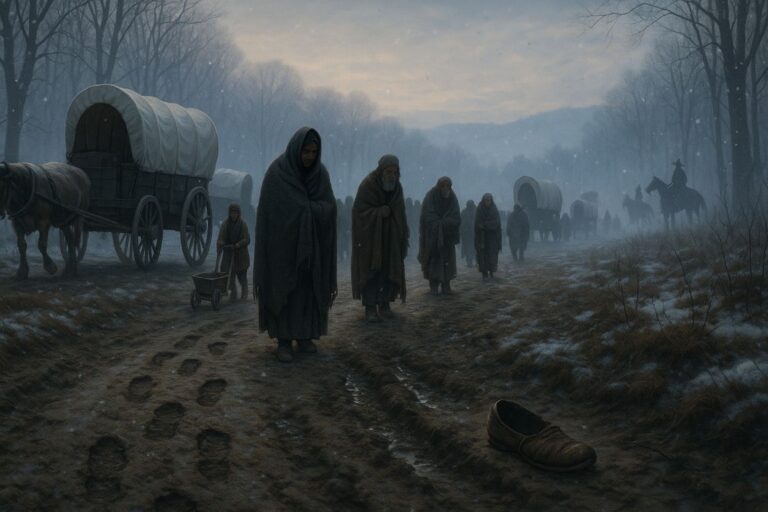
- **1830 ** – Indian Removal Act sparks forced relocations; Cherokee “Trail of Tears” (1838) claims ~4,000 lives.
- 1851 – Fort Laramie Treaty recognizes Lakota territory across the northern plains.
- 1868 – Second Fort Laramie Treaty guarantees Sioux ownership of the Black Hills (later violated).
Allotment & Assimilation (1871 – 1934)
- 1871 – Congress ends treaty-making; tribes henceforth dealt with by statute.
- 1887 – Dawes Act subdivides communal lands, eroding 90 million acres of tribal territory by 1930.
- 1924 – Indian Citizenship Act confers U.S. citizenship on all Native peoples.
- 1928 – Meriam Report exposes boarding-school abuses, laying groundwork for reform.
Reorganization & WWII (1934 – 1968)
- **1934 ** – Indian Reorganization Act halts allotment, authorizes modern tribal constitutions.
- 1942-45 – Navajo, Comanche, Choctaw and other Code Talkers serve in WWII.
- 1953 – Termination policy begins; 100+ tribes lose federal status before reversal in 1960s.
- 1968 – Indian Civil Rights Act extends most Bill-of-Rights protections to tribal jurisdictions.
Red Power & Self-Determination (1968 – 1990)
- 1969-71 – Occupation of Alcatraz amplifies “Red Power” movement.
- 1973 – Wounded Knee standoff spotlights treaty violations.
- 1975 – Indian Self-Determination and Education Assistance Act shifts federal programs to tribal control.
- 1990 – NAGPRA mandates repatriation of ancestral remains and cultural items.
Sovereignty & Cultural Revival (1990 – 2020)
- 1992 – First tribal casino compacts under the 1988 IGRA boost economic self-reliance.
- 2000s – Language immersion schools (Cherokee, Ojibwe, Hawai‘ian) fuel revitalization.
- 2013 – VAWA reauthorization recognizes limited tribal criminal jurisdiction over non-Native offenders.
- 2020 – McGirt v. Oklahoma affirms Muscogee Creek reservation boundaries.
Contemporary Era (2021 – Present)
- 2023 – Haaland v. Brackeen: Supreme Court upholds the Indian Child Welfare Act, preserving tribal placement preference in adoptions. supremecourt.gov
- 2024 – Healthcare Funding Ruling: Court orders U.S. to reimburse tribes for underfunded healthcare administration costs. nativenewsonline.net
- 2025 – Federal Recognition Momentum: Legislative and BIA efforts advance petitions for the Grand River Bands, Chinook, Lumbee and others. narf.org
Keep this timeline living! Spot an omission or want to share oral-history links? Email [email protected].
Frequently Asked Questions
Why is it called a “living” timeline?
Because tribal histories are ongoing. We update at least quarterly to reflect new scholarship, court rulings and federal recognition decisions.
Does this include every tribe?
We highlight milestones shared across many nations and list all 574 federally recognized tribes in our companion directory. State-recognized and unrecognized nations will be added as sources allow.
How accurate are population estimates for early periods?
Pre-contact numbers are scholarly estimates with wide ranges; we cite archaeologists and ethnohistorians in each deep-dive article.
How often is the timeline updated?
Quarterly, with breaking additions for landmark events (e.g., major Supreme Court rulings).
Can I contribute oral histories or photos?
Yes—submit via our contributor form. We prioritize firsthand narratives and community-approved media.