A Beginner’s Guide to Pre-Columbian Civilizations in North America
American history didn’t begin in 1492. For thousands of years before European contact, diverse Indigenous Nations built cities, engineered vast landscapes, governed through sophisticated laws, and sustained vibrant arts, faiths, and sciences.
Definition & scope. “Pre-Columbian” refers to the period before 1492. This guide focuses on North America north of Mesoamerica, so we won’t cover the Maya or Aztec here.
Terminology. Many scholars and Native communities prefer “Pre-contact” or “Ancient Indigenous societies.” You’ll also see “Ancestral Puebloans” used instead of the older exonym “Anasazi,” which many consider inaccurate or disrespectful.
Thesis. We’ll tour four major cultural regions—Southwest, Eastern Woodlands, Northern Woodlands, and the Northwest Coast—highlighting innovations in architecture, agriculture, governance, and ceremony, and connecting ancient achievements to living Nations today.
The Ancient West: Builders of stone cities (Ancestral Puebloans)
Location & timeframe
The Four Corners region of Utah, Colorado, Arizona, and New Mexico, roughly 100–1600 CE, with earlier roots and later continuities.
Architectural marvels & engineering
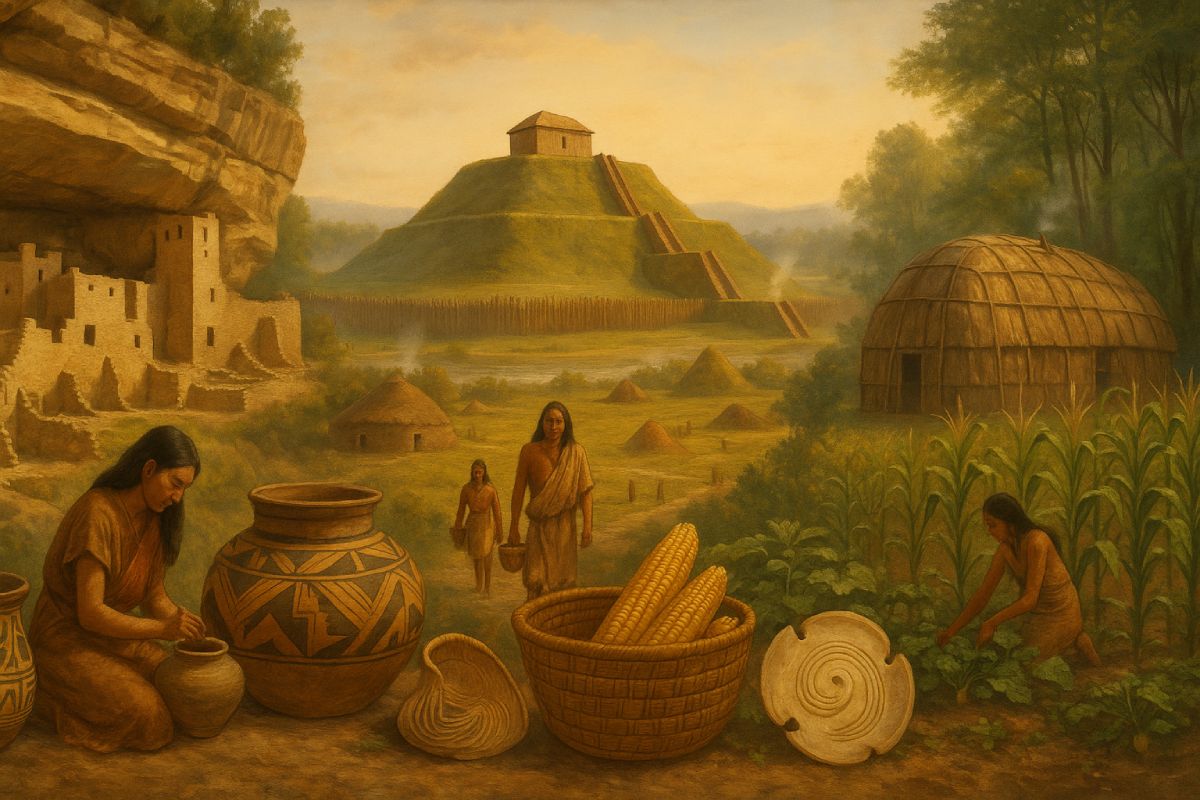
- Chaco Canyon (NM). Massive multi-story Great Houses linked by engineered roadways and sightlines. Masonry precision, astronomical alignments, and regional exchange made Chaco a ceremonial and political hub.
- Mesa Verde (CO). Dramatic cliff dwellings tucked beneath sandstone overhangs—both ecological adaptation and defensive design.
- Kivas. Subterranean ceremonial spaces (including great kivas) with ventilated fire pits, sipapus (symbolic emergence features), and bench-seating—centers of ritual and governance.
Legacy
Today’s Pueblo Nations—including Hopi, Zuni, Acoma, Laguna, Taos, Zia and others—maintain living languages, ceremonies, and land relationships tied to these ancestral places.
The Magnificent East: The Mound Builders (Mississippian world)
Who were the “Mound Builders”?
An umbrella for several related earthwork traditions:
- Adena (~800 BCE–100 CE) and Hopewell (~100 BCE–500 CE): conical and geometric mounds, long-distance exchange.
- Mississippian (~800–1600 CE): platform mounds, plazas, palisaded towns, agricultural intensification, and rich iconography.
Cahokia: North America’s largest pre-contact city
Near present-day St. Louis (Illinois), Cahokia peaked c. 1050–1350 CE. Monks Mound—the continent’s largest earthen platform mound—anchored plazas, neighborhoods, and ceremonial spaces. Woodhenges (circular timber rings) likely served calendrical roles. Population estimates vary, but many scholars suggest 10,000–20,000+ at its height.
Agriculture and the “Three Sisters”
Intercropping corn, beans, and squash supported dense populations and created resilient soils—augmented by fish, game, nuts (esp. mast harvests), and managed wetlands.
Other key sites
- Etowah (Georgia): imposing platform mounds and elite burials.
- Spiro (Oklahoma): extraordinary art and ceremonial objects from expansive Mississippian exchange networks.
The Northern Woodlands: Governance & the Great Law of Peace
The Haudenosaunee (Iroquois) Confederacy
Formed by the Five Nations—Mohawk, Oneida, Onondaga, Cayuga, Seneca—and later Tuscarora, the Haudenosaunee (hoh-deh-noh-SHOW-nee, “People of the Longhouse”) united under the Great Law of Peace. Its principles include consensus-seeking councils, checks and balances across clans and nations, diplomatic protocols, and codification through wampum.
Matrilineal leadership. Clan Mothers held (and hold) authority to nominate and remove male chiefs (sachems), anchoring accountability in women’s lineages.
Architecture
The longhouse—both a dwelling and a political metaphor—sheltered extended families with compartmental hearths and embodied the Confederacy’s ideal: many nations under one roof.
The Pacific Northwest: Art, ceremony, and abundance
Environment & resources
Rich coastal ecosystems—from cedar forests to salmon runs and whale migration routes—supported high population densities without intensive farming.
Totem poles & architectural art
Among the Tlingit, Haida, Tsimshian, and Kwakwakaʼwakw, monumental cedar arts flourished: totem poles recording lineages, histories, and spiritual beings; formline painting and carving; and massive plank houses facing communal beaches.
The potlatch
A ceremonial institution for distributing wealth, validating titles, resolving disputes, and renewing alliances. Far more than a “feast,” the potlatch integrates law, economy, art, and spirituality.
The lasting legacy of ancient innovations
Indigenous knowledge systems
- Landscape management. Controlled and cultural burning, prairie and wetland engineering, and fisheries technologies (weirs, reef-netting) shaped biodiverse “cultural landscapes.”
- Science & observation. Calendrical astronomy, hydrology, soil building, and seed selection underpinned sustainable food systems across regions.
Debunking the myths
North America was not an “empty wilderness.” It was a mosaic of managed homelands—with cities, towns, seasonal camps, trade routes, and diplomatic networks—long before European arrival.
Frequently Asked Questions
What does “Pre-Columbian” mean?
The period in the Americas before 1492, describing Indigenous cultures prior to sustained European contact.
What was the largest Pre-Columbian city in North America?
Cahokia (in present-day Illinois) was the largest known urban center north of Mesoamerica, peaking around 1100 CE, with population estimates often exceeding 15,000.
What are the Ancestral Puebloans most famous for?
Sophisticated stone and adobe architecture—the Great Houses of Chaco Canyon and cliff dwellings at Mesa Verde—plus kivas for ceremonial life.
Did Pre-Columbian societies have complex governments?
Yes. The Haudenosaunee Confederacy exemplifies codified consensus democracy under the Great Law of Peace, with Clan Mothers overseeing leadership.
Where can I see Pre-Columbian sites today?
Many are preserved as parks and historic sites, including Mesa Verde National Park (CO), Chaco Culture National Historical Park (NM), and Cahokia Mounds State Historic Site (IL).
Conclusion
Pre-contact North America spans millennia of innovation, diplomacy, engineering, and art. These are not “lost” civilizations—they are the ancestors of living Nations who continue to steward languages, lands, and laws. Understanding this depth reshapes how we see the continent’s past—and how we respect its present.