How Schools Can Teach Native American History Accurately
Schools teach Native American history more accurately when they name specific Nations, use Native-authored and Tribally developed sources, explain sovereignty and connect historical events to living communities. This work belongs throughout the school year, across history, civics, literature, science and the arts.
Native history should not appear only in November, begin with European arrival or end in 1890. Native Nations existed before the United States and continue to govern, create, educate and defend their rights today.
For K–12 teachers and curriculum leaders, the practical task is to improve both the evidence students encounter and the questions they ask. Adding a few facts will not correct a lesson that treats distinct peoples as interchangeable or presents them only in the past.
1. Begin with specific Nations and homelands
There is no single Native American culture, language or historical experience. A lesson about Wampanoag communities should not use Plains clothing as a generic illustration. Cherokee removal cannot stand in for the distinct histories of Muscogee, Choctaw, Chickasaw or Seminole peoples.
The Smithsonian’s Native Knowledge 360° Essential Understandings offers a framework developed with Native communities, educators and education agencies. It emphasizes cultural diversity, historical change and contemporary life. Use that framework alongside the relevant Nation’s public history and educational materials.
Identify the peoples connected to the place and period being studied, including communities displaced from that homeland. Consult Tribal government websites, education departments, museums and historic-preservation offices. A state boundary or present-day office address does not define an ancestral homeland. A land acknowledgment can introduce inquiry, but it cannot replace it.
2. Teach sovereignty through governments and evidence
Students need to encounter Tribal Nations as governments as well as cultural communities. The Essential Understandings’ governance theme describes political systems that predate European colonization and contemporary governments that enact laws, operate courts and manage resources and services. Their authority operates within legal relationships shaped by treaties, statutes and court decisions.
Treaties are agreements between sovereign governments. Teach who negotiated a particular agreement, what it says, the pressures surrounding it and how the parties understood their obligations. Do not imply that every agreement was freely negotiated or that every Nation has the same treaty history.
Pair an age-appropriate treaty excerpt with the Nation’s explanation or a public statement about a related issue today. Ask students to support a claim with evidence. Keep ancestry, Tribal citizenship and governmental sovereignty distinct; a classroom activity cannot determine anyone’s citizenship.
3. Evaluate sources, including primary sources
A primary source is evidence from a particular context, not a guarantee of accuracy. A federal agent’s report, photograph or newspaper story can reveal the creator’s assumptions as well as information about an event. Students should ask who produced it, when, for which audience and whose account is missing.
Build a source set that includes Native people speaking for themselves. Useful materials can include:
- Public Tribal government statements, constitutions, laws and education resources.
- Oral histories released for educational use, with the speaker, Nation and recording context identified.
- Native journalism, essays, books and public speeches attributed to their creators.
- Treaties, archival records and museum materials examined alongside relevant Native accounts.
The National Indian Education Association’s Native Education 101 provides background on Native education, practices and legislation. Its culturally based curriculum collection offers additional starting points. Evaluate each linked item’s authorship, date, context and grade suitability rather than assuming every resource in a collection has the same community review.
Distinguish an author’s individual perspective from an official government position. Credit Native creators using their publicly stated affiliations. Follow the source’s conditions for stories, images, recordings and seasonal teachings; online availability does not make every cultural practice appropriate to reproduce.
4. Connect historical units to contemporary life
Build a contemporary connection into each unit. Removal can lead to study of a Nation’s current government and relationship with its homelands. Boarding-school history can connect to language reclamation and community-led education. Treaty study can follow a Nation’s public work on water, fishing or land.
The Smithsonian’s Native Knowledge 360° program combines fuller histories with contemporary Native perspectives. Its lesson finder lets educators search by grade, subject and resource type.
Include ordinary life and achievement alongside conflict: families, artists, scientists, colleges, businesses, journalism and language programs. Avoid teaching Native people only as victims or assuming that urban life and contemporary technology make someone less Native.
5. Replace stereotyped activities with inquiry
Do not ask students to dress up as Native people, make imitation headdresses or ceremonial masks, invent “Indian names” or recreate ceremonies. The National Museum of the American Indian’s Native American Is Not a Costume guidance explains how generalized costumes misrepresent diverse living cultures. Students can study named artists, clothing and design without impersonating the people involved. Our regalia and costume guide offers further context.
Replace classroom removal games or abuse reenactments with document analysis, maps, timelines and accounts that people have chosen to share. Do not ask students to pretend to experience forced displacement or boarding-school abuse, or to invent first-person testimony in a survivor’s voice.
For Thanksgiving, use the Smithsonian’s “First Thanksgiving” inquiry to examine evidence and Wampanoag perspectives rather than stage a generic feast. Students can compare a popular retelling with a documented account and explain what changes when additional voices are included.
Hands-on learning is still possible. Distinguish improvised impersonation from a carefully designed program offered by Native educators. For example, NIEA provides Indigenous Empowerment & Resilience Training developed with Indigenous Elders, knowledge keepers and educators. Schools considering such programs should follow the provider’s facilitation, audience and participation guidance rather than recreate them from a short description.
6. Match the task to students’ ages
The examples below are planning suggestions, not a prescribed curriculum. Select sources for students’ reading levels and learning needs, and check the original lesson’s age guidance and local standards.
| Grade band | Possible inquiry | Evidence of learning |
|---|---|---|
| K–2 | Read a contemporary Native-authored picture book and use a public community resource to learn the Nation’s name and location. | Students identify the named community and describe its members as people living today. |
| 3–5 | Compare a textbook paragraph with a Nation’s public account of a local place or event. | Students identify a difference and explain which source supports their correction. |
| 6–8 | Examine a treaty excerpt alongside the Nation’s explanation and a contemporary public statement. | Students make a sourced claim about an obligation or relationship that continues. |
| 9–12 | Investigate a policy through government records, Native testimony and present-day Tribal reporting. | Students corroborate evidence, identify source limits and distinguish historical policy from current authority. |
Prepare students before teaching violence or family separation. Explain the material’s purpose, avoid unnecessary graphic detail and offer an equivalent way to meet the learning objective when needed. Never require students to disclose family experiences or ask a Native student to validate the lesson.
The Smithsonian’s boarding-school chapter in Native Words, Native Warriors models questions grounded in images, narration and individual accounts. Preview every selection for your class. The boarding-school history and healing guide provides additional background for educators.
7. Build relationships before finalizing local content
Ask the relevant Tribal education office how it prefers to work with schools. Agree on the question, materials, review process, timeline, attribution and compensation before requesting substantial work. One Native parent, student or employee cannot be expected to represent every Nation or supply unpaid curriculum review.
Montana’s Indian Education for All describes curriculum development with cultural consultants from Montana Tribal Nations and review by representatives of those Nations. Washington’s John McCoy (lulilaš) Since Time Immemorial curriculum uses place-based, inquiry-based and integrated approaches; its official page reports endorsement by all 29 federally recognized Tribes in Washington.
These are useful models of collaboration. Their regional content is not a replacement for learning about Nations in another place. Check your own state’s requirements and the original program’s adaptation guidance.
Use existing public educational resources while building relationships. Do not claim that a Nation approved your lesson merely because you consulted its website or invited someone to comment. Identify exactly what was reviewed, by whom and for which purpose. A lack of response is not endorsement.
8. Audit the lesson and assess what students understand
Before using or approving a lesson, ask:
- Specificity: Are the Nations, places, dates and image captions accurate?
- Continuity: Are Native people visible before colonization and in contemporary life?
- Sources: Does the lesson include a relevant Native-authored or Tribally developed account, with authorship and context identified?
- Government: Does it distinguish sovereignty, citizenship, ancestry and land status?
- Activities: Have stereotyped costumes, ceremonial imitation and improvised reenactments of coercion been replaced?
- Permissions and review: Are cultural conditions, publication rights and any community review described accurately?
- Student participation: Can students learn without disclosing identity or family history, or speaking for a community?
- Assessment: Must students support conclusions with evidence rather than repeat a stereotype or an unsupported generalization?
For a manageable first step, revise one upcoming lesson: identify the Nation, replace one weak source, add a contemporary connection and change the assessment to require evidence. Record the sources and revisit the lesson as community guidance and scholarship develop.
Accurate teaching is an ongoing practice. It gives students the tools to understand Native Nations as distinct peoples and governments whose histories continue to shape the present.
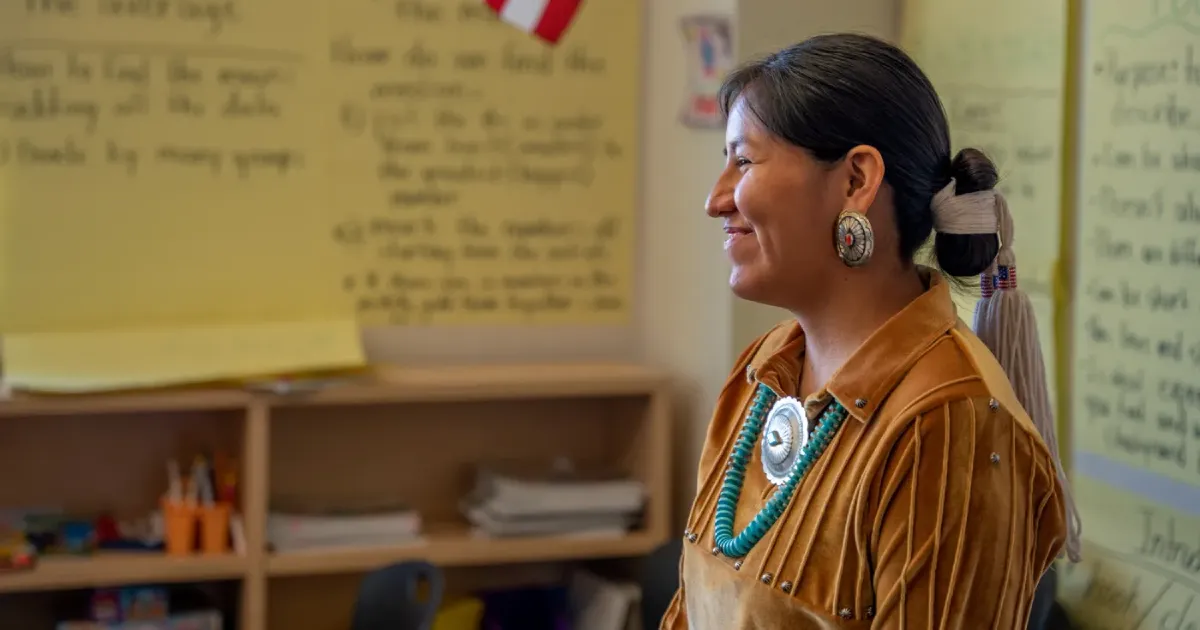
(Picture via Getty Images)