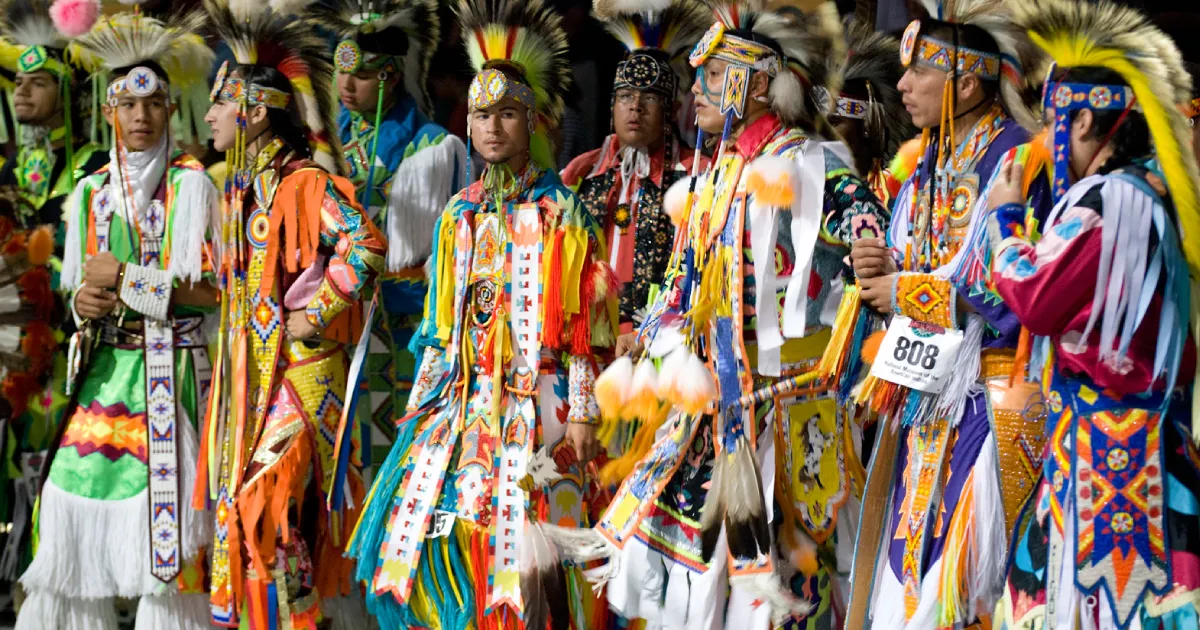
Regalia vs. Costume: The Correct Words and Why They Matter
The clothing a Native person wears at a powwow, community gathering, public dance or ceremony should not automatically be called a costume. In many settings, “regalia,” “traditional clothing,” “apparel” or “outfit” is more accurate. The best term is the one used by the wearer and the community.
The difference is not a rule about one forbidden dictionary word. It is about context and power. A costume is commonly worn to portray a character or pretend to be someone else. Native regalia is worn by Native people expressing who they are—their Nation, family, community, dance style, history, creativity or responsibilities.
What does “regalia” mean?
Regalia can include clothing, moccasins, beadwork, jewelry, shawls, belts, fans, headwear and other items assembled for a particular cultural setting.
There is no single “Native American regalia.” Nations and regions have distinct clothing traditions, and even within a shared powwow dance category, each person’s regalia may be individual.
The Smithsonian’s National Museum of the American Indian describes powwow regalia as an expression of community, culture, family, spirituality and personal choice. Its materials may combine older techniques with contemporary cloth, colors and designs.
Pieces may be made by the wearer, commissioned from an artist, purchased, inherited or given by relatives and community members.
It is tempting to explain the distinction by saying that all regalia is sacred or must be earned. That is also too broad. Some items carry ceremonial restrictions or mark honors and responsibilities; others are created for social dancing, celebration, artistic expression or everyday cultural continuity.
Meanings and protocols belong to the relevant Nation, family, society and wearer.
Not all Native clothing is regalia
Native people wear the same wide range of everyday clothing as everyone else. They also create contemporary fashion, streetwear, formalwear and jewelry that may express Native identity without being ceremonial regalia.
The National Museum of the American Indian emphasizes in its “Native American Is Not a Costume” guide that Native cultures are present-day and changing. Native designers often combine contemporary fashion with community traditions.
Treating buckskin, fringe or feathers as the only visible signs of Native identity freezes Native people in a generic historical image and overlooks how they live and create now.
Why “Native costume” causes harm
Generic costumes usually combine elements taken from unrelated Nations: a Plains-style feather headdress, synthetic fringe, face paint and invented symbols. The result is not an accurate representation of any community. It turns hundreds of distinct Nations into one fictional character.
The harm is especially clear in classrooms and at Halloween. The National Museum of the American Indian advises educators not to ask students to “dress up” as Native Americans or make imitation masks and headdresses.
In some communities, those items may be used only by people with particular roles, knowledge or status. Copying their appearance removes those relationships while teaching children that Native identity is something anyone can put on and discard.
Using “costume” for a Native dancer’s actual clothing can repeat that same message. It may imply performance for an outsider’s entertainment rather than participation in a living social, cultural or spiritual practice.
How to act respectfully at a powwow or public dance
Guests usually do not need special clothing. Wear ordinary, respectful attire and follow the host’s instructions. If the master of ceremonies invites everyone into an intertribal or social dance, visitors may participate as directed without pretending to be Native.
Do not touch a person or any part of their regalia without permission. Ask before taking an individual photograph, and obtain a parent or guardian’s permission before photographing a child. Some songs, dances and moments cannot be recorded at all.
Powwow guidance from the Council of Three Rivers American Indian Center stresses that permission and host instructions control photography and recording. Policies can change from one community or event to another, so an earlier visit is not permanent permission.
If a feather or another item falls, do not pick it up. Alert the wearer, arena director or event staff. Organizers may follow a specific protocol that visitors should not interrupt.
The Indian Pueblo Cultural Center similarly cautions that public dances can be social or sacred cultural expressions and that rules differ among Pueblos and dance groups. Public attendance does not make an image available for commercial use.
Can non-Native people wear Native-designed clothing?
There is an important difference between wearing a generic “Indian costume” and buying clothing or jewelry that a Native artist has intentionally made for public sale.
Supporting Native designers can be respectful when the creator accurately identifies the work and presents it for general use.
Do not assume that purchasing an item grants permission to copy its design, claim an affiliation or wear it in every setting. Ask the artist if the intended use is unclear. Avoid sellers who use vague labels such as “tribal” or “Native-inspired” while concealing who made the product.
Better language for writers and educators
Identify the person and Nation when that information is public and relevant. Describe the specific garment or dance style instead of relying on “traditional Native dress.”
Use the wearer’s preferred term—often regalia, outfit, traditional clothing or apparel—and explain only meanings that the person or community has made public.
For lessons, study the work of a named Native artist, compare public clothing traditions from specific Nations or explore how Native designers connect heritage with contemporary life. Do not ask children to manufacture imitation regalia.
Respect begins with accurate language, but it does not end there. The point is not simply to replace “costume” with “regalia” and continue treating Native clothing as spectacle. It is to recognize living people, distinct Nations and the relationships that give each item meaning.