Tribal Gaming Explained: Law, Revenue and Common Myths
Tribal gaming is government-regulated economic activity conducted by sovereign Tribal Nations on eligible Indian lands. It is governed by Tribal law and the federal Indian Gaming Regulatory Act, commonly called IGRA. States have defined roles in Class III gaming, but they do not own Tribal casinos or create Tribal sovereignty.
The law is easier to understand when three questions are kept separate: which government may conduct gaming, whether the land is eligible, and which class of game is involved. Federal recognition alone does not answer all three.
The legal framework grew from Tribal authority and federal legislation
In 1987, the U.S. Supreme Court decided California v. Cabazon Band of Mission Indians. The Court distinguished state laws that prohibit gaming from laws that regulate gaming and rejected California’s attempt to apply its bingo rules through Public Law 280. Congress enacted IGRA the following year, creating a national framework while preserving significant Tribal regulatory authority. The National Indian Gaming Commission history explains that compromise.
IGRA’s stated goals include Tribal economic development, self-sufficiency and strong Tribal governments. It created the National Indian Gaming Commission, or NIGC, and defined the land, governmental and regulatory conditions for gaming. The statute does not give every federally recognized Nation a casino license. See the Indian Gaming Regulatory Act.
IGRA divides gaming into three classes
Class I remains under exclusive Tribal jurisdiction
Class I covers social games for minimal prizes and traditional forms of gaming connected with Tribal ceremonies or celebrations. IGRA leaves this category within the exclusive jurisdiction of Tribal governments. Public descriptions should not turn that legal definition into an invitation to document ceremonial activity.
Class II includes bingo and certain card games
Class II includes bingo, including games played with permitted technological aids, along with closely related games and certain non-banked card games. It does not include slot machines or house-banked games such as blackjack. Tribal governments are the primary regulators, and a Tribe must adopt a gaming ordinance approved by the NIGC Chair before opening. The NIGC gaming ordinance page explains that approval requirement.
Class III covers other casino-style gaming
Class III is the residual category for games outside Classes I and II. It includes slot machines, roulette, craps and house-banked card games. Lawful Class III gaming generally requires an approved Tribal ordinance, a form of gaming permitted by the state, and a Tribal-state compact that has taken effect after federal review. Indian Affairs maintains a public gaming compacts database.
Eligible land and regulatory approval both matter
IGRA defines Indian lands through reservation boundaries and certain trust or restricted lands over which a Tribe exercises governmental power. Gaming on land acquired after October 17, 1988 is generally restricted unless a statutory exception applies. Those exceptions include circumstances involving settlement of land claims, initial reservations and restoration of lands for restored Tribes. The controlling text is 25 U.S.C. § 2719.
A proposed facility therefore may involve land-into-trust decisions, an Indian-lands determination, a Tribal ordinance, environmental review and, for Class III gaming, compact negotiations. The steps depend on the Nation, parcel and proposed games. Recognition by itself does not establish that any chosen property is gaming-eligible.
Tribes are the primary regulators
Tribal governments license facilities and key employees, conduct background checks, establish internal controls and create Tribal gaming regulatory authorities. NIGC oversees Class II gaming and specified aspects of Class III gaming under federal law. State roles for Class III gaming arise through IGRA and the applicable compact. The NIGC frequently asked questions summarizes these responsibilities.
This shared framework does not erase sovereignty. A compact is a government-to-government agreement. Its terms may address permitted games, jurisdiction, standards and state regulatory costs, but each compact must be read on its own.
Gross gaming revenue is not profit
NIGC reported $46.2 billion in gross gaming revenue for fiscal year 2025, based on independently audited statements from 545 gaming establishments operated by 246 Tribes in 29 states. NIGC defines gross gaming revenue as wagers minus winnings paid to players. It is not net profit, cash available for distribution or the total economic output of Tribal enterprises. See the July 21, 2026 revenue release.
The figures also show why national totals can mislead. Facilities differ greatly in market size, debt, operating costs and location. Many recognized Tribal Nations operate no gaming facility, while some governments operate more than one.
IGRA limits how net gaming revenue may be used
IGRA directs net revenues to Tribal government operations and programs, the general welfare of the Tribe and its citizens, Tribal economic development, charitable donations and local-government operations. A Nation may choose per-capita payments, but it is not required to do so. Such payments require an approved revenue allocation plan and must follow federal and Tribal rules. The relevant requirements appear in 25 U.S.C. § 2710.
Five common myths about Tribal gaming
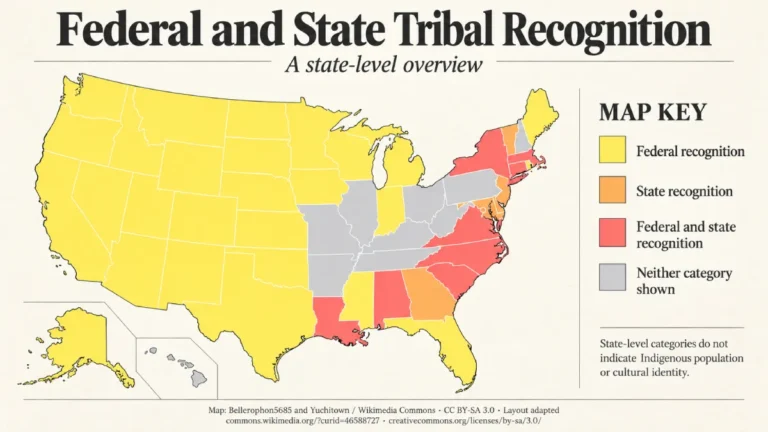
Myth one: every Tribe owns a casino. The FY2025 report covered 246 Tribes, far fewer than the 575 entities on the current federal recognition list. Myth two: recognition automatically authorizes gaming. Eligible land, state law, an approved ordinance and the class of game still matter.
Myth three: states control Tribal casinos. Tribal governments are the primary regulators; state authority depends on federal law and compact terms. Myth four: casino revenue goes directly to every citizen. Per-capita payments are optional, and many Nations use revenue for government services and economic development. Myth five: the national revenue total measures Tribal wealth. Gross gaming revenue is an industry measure, not profit or a measure of the financial position of every Nation.
The accurate question is not whether Tribes have a special exemption from ordinary law. It is how Tribal, federal and compact-based authority operates for a particular Nation, parcel and form of gaming.