7 Indigenous Scientists and Climate Leaders to Know
Indigenous scientists and climate leaders work across universities, Tribal colleges, Native-led organizations and community partnerships. Their fields include hydrology, environmental engineering, plant ecology, public health, ethics and international climate policy.
This list is a starting point, not a ranking or a claim that one person represents all Indigenous knowledge. Each profile uses the Nation or community affiliation published by the person or an official institution. Readers should follow the linked source for the person’s current work.
Karletta Chief brings water science into community partnerships
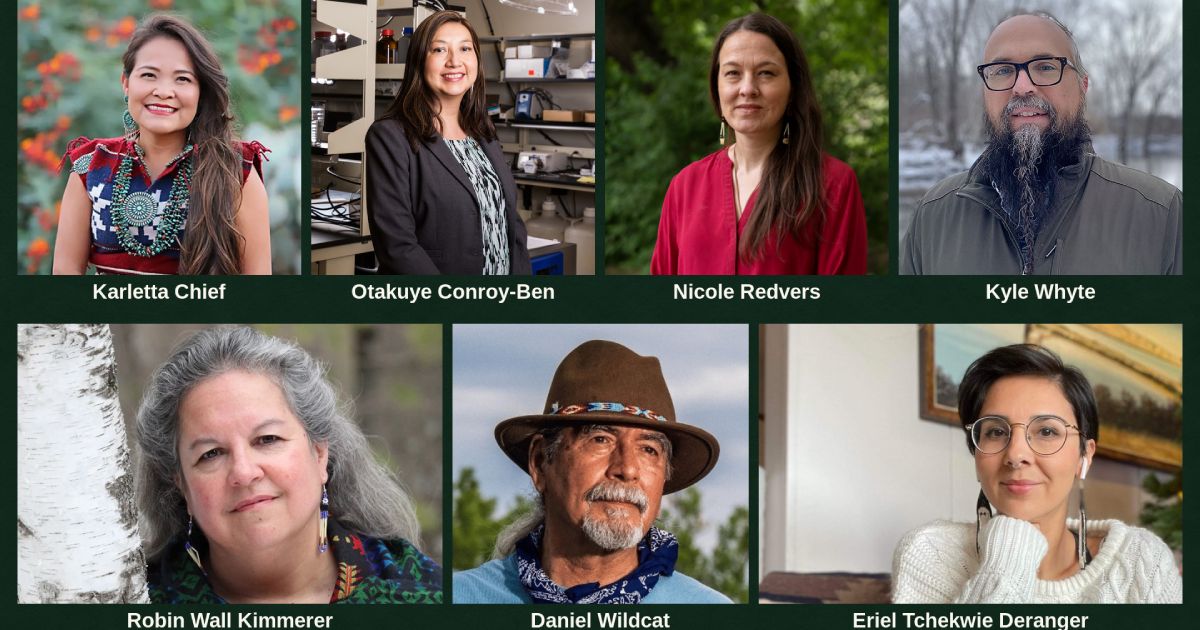
Karletta Chief is Diné and a professor and extension specialist in environmental science at the University of Arizona. She directs the university’s Indigenous Resilience Center. Her work includes water research, climate adaptation and community-engaged projects addressing the Gold King Mine spill and food, energy and water security. The center describes its role as connecting university researchers with Native Nations facing climate and environmental challenges. See Chief’s University of Arizona profile.
Chief’s career shows why the method of research matters alongside the data. Community priorities, culturally appropriate communication and training Native graduate students are part of the work, rather than additions made after a study is complete.
Otakuye Conroy-Ben studies water contamination and public health
Otakuye Conroy-Ben is Oglala Lakota and an associate professor in Arizona State University’s School of Sustainable Engineering and the Built Environment. Trained in chemistry and environmental engineering, she studies the biological effects of polluted water, antibiotic resistance, wastewater epidemiology and contaminant movement. Her ASU faculty profile also identifies her work with the university’s American Indian Science and Engineering Society chapter.
Her research connects infrastructure and environmental exposure. That focus is especially important where rural and Tribal communities face underinvestment in water systems, but any project still needs Nation-specific evidence rather than a generalized claim about Native communities.
Nicole Redvers connects planetary health with Indigenous health
Nicole Redvers is a member of the Deninu K’ue First Nation in the Northwest Territories. At Western University, she is an associate professor, Western Research Chair and director of Indigenous Planetary Health. Her research links human health, ecosystems, Indigenous knowledge translation and global health. Western’s official faculty page lists her work on the determinants of planetary health and health practices that can benefit both patients and the environment.
Planetary health asks how changes to climate and ecological systems affect human well-being. Redvers’ work adds a necessary question: whose knowledge, governance and relationships to land shape the response?
Kyle Whyte examines climate justice and institutional responsibility
Kyle Whyte is an enrolled citizen of the Citizen Potawatomi Nation and the George Willis Pack Professor at the University of Michigan’s School for Environment and Sustainability. His research addresses moral and political questions Indigenous peoples face in climate change, conservation and relationships with scientific institutions. The university’s Kyle Whyte profile lists his work in environmental justice, transboundary waters and national and international assessment bodies.
Whyte’s scholarship helps readers move beyond a narrow focus on physical impacts. Climate planning also involves consent, treaty relationships, displacement, institutional trust and whether communities control the decisions that affect their futures.
Robin Wall Kimmerer joins plant ecology with reciprocal responsibility
Robin Wall Kimmerer is an enrolled member of the Citizen Potawatomi Nation, a plant ecologist and a SUNY Distinguished Teaching Professor. She founded the Center for Native Peoples and the Environment at SUNY College of Environmental Science and Forestry and now serves as its director emeritus. Her research and teaching address plant ecology, restoration and relationships between Indigenous knowledge and scientific practice. See SUNY ESF’s current profile.
Kimmerer’s books have introduced many readers to reciprocity and care for land, but a popular book should not be used as a universal guide to every Nation’s knowledge. Her work is strongest when read with its Potawatomi, botanical and educational context intact.
Daniel Wildcat builds climate research through a Tribal college
Daniel Wildcat is a Yuchi member of the Muscogee Nation of Oklahoma and a professor at Haskell Indian Nations University. His work brings Indigenous knowledge, environmental science, education and public policy into relationship. Haskell’s 2026 profile describes his role in building the Haskell Environmental Research Studies Center and the Rising Voices, Changing Coasts Research Hub.
That Tribal-college setting matters. It supports research training and partnerships in which Indigenous methodologies are part of climate science from the beginning, rather than treated only as community outreach.
Eriel Tchekwie Deranger organizes for Indigenous climate authority
Eriel Tchekwie Deranger is a Dënesųłiné member of the Athabasca Chipewyan First Nation and co-founder and president of Indigenous Climate Action. The organization works on climate justice, Indigenous rights and international advocacy. Its current COP31 delegation page lists Deranger as president while Indigenous representatives participate in negotiations in Türkiye during November 2026.
Deranger is included as a climate leader rather than an academic scientist. Her work demonstrates that climate action also occurs through organizing, policy advocacy and the defense of Indigenous jurisdiction. Scientific evidence cannot decide questions of rights or consent by itself.
Read the work and name the community
A respectful profile verifies affiliation, identifies the person’s actual field and links to current work. It does not label every Indigenous advocate a scientist or turn one scholar into a spokesperson for all Native peoples.
Readers can continue by following the institutions these leaders build, including Tribal colleges, Native-led climate organizations and community research centers. Those structures make long-term research and mentorship possible beyond any single public figure.