Native Nations Directory: Find All 575 Federally Recognized Tribal Entities
The latest published federal list contains 575 federally recognized American Indian and Alaska Native Tribal entities. The Department of the Interior published that list on January 30, 2026; the Bureau of Indian Affairs’ Tribal Leaders Directory also reports 575. Both sources were checked for this guide on November 8, 2026.
Use the resources below to reach the complete list, locate government contacts and confirm a Nation’s own public information. The list includes governments called Nations, Tribes, bands, pueblos, rancherias, communities and Alaska Native villages.
A familiar name alone may not identify the right government. Similar names can belong to distinct Nations, and a federal listing may differ from the shorter name a Nation uses publicly.
Find the complete Native Nations directory
| What you need | Where to go | How to use it |
|---|---|---|
| All federally recognized entities | January 30, 2026 Federal Register list | Search the published names and any former-name notes. |
| The official published PDF | Federal Register PDF on GovInfo | Use the official electronic edition when precise legal citation matters. |
| Government contacts and locations | BIA Tribal Leaders Directory map | Locate a government office and its associated BIA region or agency. |
| Directory data for a spreadsheet | BIA directory data and download options | Follow the download options linked from the BIA’s directory service page; verify records before reuse. |
If a map or data portal fails to load, return to the BIA directory landing page for its current links. The federal notice remains available as searchable text and a PDF.
Use the federal list for status and the directory for contacts
The Federal Register notice is the published recognition list. The BIA contact directory is a practical reference: its disclaimer expressly says it is not the official listing of federally recognized Tribes. The BIA also cautions that it cannot track every leadership change in real time and does not guarantee the accuracy of directory contact information.
Under 25 U.S.C. § 5131, the secretary of the interior must publish the recognition list annually on or before January 30. Always check a notice’s publication date rather than assuming a high-ranking search result is the latest edition.
The notice has separate sections for entities in the contiguous 48 states and Alaska. Search both the current name and any previous names or cross-references. A parenthetical former name generally helps identify the same entity; it should not automatically become a second directory entry.
For a reported recognition or restoration after an annual notice, check the enacted law or other controlling federal action and current BIA information. The date of a legal change and the date it appears in an annual list can differ.
How to verify the correct Tribal Nation
- Start with the published federal name. Search the Federal Register notice, then use the BIA directory to locate contact information.
- Compare location and name together. Do not merge governments because they share a word, ancestral connection or regional identity. For example, “Delaware Nation, Oklahoma” and “Delaware Tribe of Indians” are separate federal listings.
- Confirm the official government website. Check the government and contact pages against the directory. If the information conflicts, use a verified public office contact to ask which website or address is current.
- Choose the right office. Citizenship questions belong with the Nation’s citizenship or enrollment office; media, cultural and general government requests may go elsewhere.
- Record what you checked and when. Keep the source link, verification date and any unresolved differences. Recheck leadership before publishing a person’s name or title.
Use the exact federal listing when discussing recognition or citing a legal record. In general reporting, follow the Nation’s preferred public name and capitalization. When the names differ substantially, identify both once so readers can connect the sources.
What if a Nation does not appear in your search?
A failed search is a reason to investigate further. Try a distinctive part of the name, alternative spellings, a former name or the name of an affiliated group. In Alaska, a listing may begin with “Native Village of,” “Village of,” or another governmental designation rather than the place-name alone.
Check whether the result you found is a Tribal government, an Alaska Native corporation, a cultural organization or a nonprofit. Each may have an important role, but they are different kinds of entities.
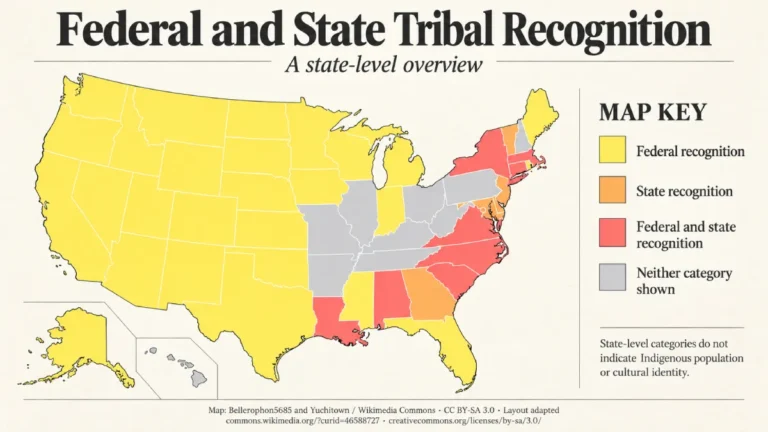
Some communities hold state recognition without federal recognition; others have different recognition histories or are seeking acknowledgment. Their absence from the federal list does not, by itself, settle questions of ancestry, community history or cultural identity. Our federal and state recognition guide explains the legal distinction.
Why the federal count increased from 574 to 575
The December 11, 2024 notice reported 574 entities. Congress enacted full federal recognition for the Lumbee Tribe of North Carolina on December 18, 2025, through legislation included in the National Defense Authorization Act for Fiscal Year 2026. The Lumbee Tribe’s recognition account records that date, and Interior added the Tribe to the January 30, 2026 list.
Recognition does not mean every federal service became available immediately. The 2026 notice identifies conditions including verification of the Tribal roll, assessment of service needs and a general delay in service delivery until the third fiscal year following enactment. Program eligibility and implementation must be checked separately.
Resources describing the Lumbee Tribe solely as state-recognized are therefore outdated. A count of 574 may accurately describe an older edition, but it should not be presented as the current federal total.
What this directory can—and cannot—tell you
Recognition concerns a political relationship
The BIA’s definition of federal recognition describes a government-to-government relationship with the United States and associated responsibilities, powers, protections and limitations. This is not a directory of every Indigenous people or historical Nation in North America. Nor is recognition a federal measure of cultural worth.
Citizenship is determined by the Nation
The BIA’s ancestry and enrollment guide explains that each Tribe sets its own enrollment requirements and keeps its own records. The BIA does not maintain a universal citizen database or conduct individual genealogy research. A directory entry, surname match or family story cannot establish someone’s citizenship. Start with documented family connections and the Nation’s current requirements; see our Native American ancestry research guide.
Office locations are not territorial boundaries
The BIA describes its map as a reference for general office and headquarters locations, not a source for legal boundaries. An office address does not define a Nation’s homelands, reservation or jurisdiction. The BIA also confirms that not every federally recognized Tribe has a reservation. Our reservation guide explains why a Nation, a reservation and a parcel’s land status are different things.
Alaska Native governments and corporations are distinct
The list includes Alaska Native Tribal entities. It is not a directory of corporations established under the Alaska Native Claims Settlement Act. Federal guidance distinguishes these Tribal governments from Alaska Native corporations. When researching an Alaska community, establish which entity’s government, services or business activities you need to contact.
Build and maintain a useful directory entry
For publishers and researchers, a compact entry should preserve the distinction between a federal name and the Nation’s own presentation. Include verified public information such as:
- Federal listing: the published name, with former-name notes stored separately.
- Preferred public name: the name and spelling used by the Nation.
- Government website and public contact: the official site, relevant office and public telephone number or contact page.
- Office location and BIA region or agency: labeled as administrative information, with no implication that these define cultural or territorial boundaries.
- Sources and dates: the federal notice date, source URLs and date each contact record was last checked.
Do not infer population, citizenship rules, language or cultural identity from a government’s name, state or BIA region. Consult the Nation’s own materials before adding those subjects.
If you download directory data, retain its source and retrieval date. Avoid treating a row count as proof of recognition: files can include cross-references, administrative records or a different update date. Reconcile recognition claims with the published notice and any subsequent legal changes.
This guide’s sources were last checked on November 8, 2026. Its next scheduled editorial review is January 31, 2027, after the statutory annual publication deadline. Check earlier whenever a recognition change or broken link is reported.
A reliable directory leads readers to the correct sovereign government. Federal sources establish the published recognition record; the Nation itself is the source for its current government, citizenship requirements and public information.