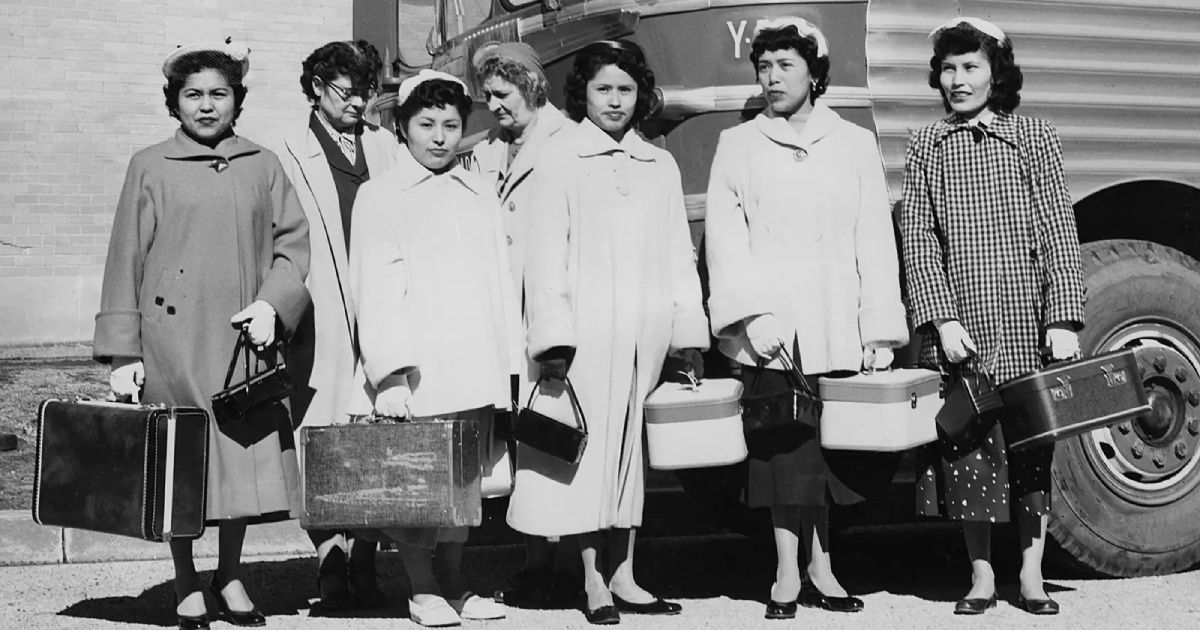
The Termination and Urban Relocation Era: Federal Policy and Native Resistance
Termination and urban relocation were related federal assimilation policies, but they operated differently. Termination targeted the federal relationship with particular Tribal Nations and the protections attached to it. Relocation encouraged Native people to move from reservations to cities through employment assistance and vocational training.
Both became defining policies of the 1950s and 1960s. Their consequences reached beyond government paperwork: families faced changes in land ownership, services, work and community life. Native people responded through political organizing, legal challenges and institutions that remain part of urban Native life today.
Termination vs. relocation: the key differences
| Question | Termination | Urban relocation |
|---|---|---|
| Primary focus | The federal relationship with particular Tribal Nations and communities. | Employment and training for Native individuals and families moving to urban areas. |
| How it operated | Separate laws changed recognition, services and land protections for affected communities. | Bureau of Indian Affairs programs offered help with moving, job placement and training. |
| What it did not mean | A federal action could not erase a people’s identity or continuing community relationships. | Moving to a city did not itself terminate a person’s Tribal Nation or automatically cancel Tribal citizenship. |
The distinction matters when reading family histories. A person could participate in relocation without belonging to a terminated Nation. A Nation could experience termination while many of its citizens remained in their homeland.
What federal termination meant
On August 1, 1953, Congress announced its termination policy through House Concurrent Resolution 108. The resolution called for ending federal supervision over named Nations and Native communities. It expressed congressional policy; separate legislation carried out termination.
Termination could end federal recognition and related services, remove land from federal trust protection, and expose property to taxation, sale or division. Its effects depended on the particular act. The National Archives’ termination overview reports 60 separate termination proceedings between 1953 and 1970 and the relinquishment of more than three million acres of Tribal land. That is a count of proceedings, not simply a count of Nations.
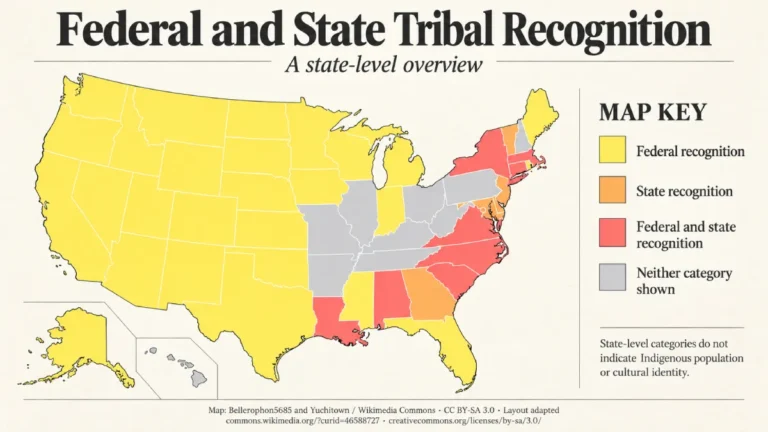
Federal recognition concerns a political and legal relationship. Losing it did not mean that a Native community ceased to exist. For background, see our guide to federal and state recognition.
Menominee and Klamath experiences show what was at stake
Congress enacted the Menominee Termination Act in 1954, with termination taking effect in 1961. The Menominee Indian Tribe of Wisconsin’s historical timeline describes the difficult work of reorganizing government and the timber enterprise while protecting the land for future generations. The pressures included the cost of services and the future of the forest that sustained community livelihoods.
The Klamath Tribes’ own history records opposition by elected Tribal representatives to the 1954 Klamath Termination Act. It describes the loss of recognition, services and the reservation land base, followed by years of work toward restoration.
The Klamath account also makes an important legal distinction: termination did not erase every treaty right. A 1974 federal court ruling affirmed retained hunting, fishing and gathering rights. The history of any affected Nation requires attention to its treaties, termination law and later decisions, rather than an assumption that all rights disappeared at once.
Public Law 280 was a separate jurisdiction law
Enacted on August 15, 1953, Public Law 280 expanded state authority over certain criminal matters and civil litigation in Indian country. It belonged to the same period of federal policy, but it did not automatically terminate the Nations within the affected states.
As the Bureau of Indian Affairs explains, authority to hear civil cases did not amount to a general grant of state regulatory or taxing power over Tribal governments and trust lands. The law’s application also varies with exceptions and later changes. Recognition, land status and court jurisdiction are connected questions, but they should not be treated as interchangeable.
How the urban relocation program worked
The BIA established its Branch of Placement and Relocation in 1951, before the 1953 resolution. Early field offices included Denver, Salt Lake City and Los Angeles; the program later reached Chicago, San Francisco and other cities.
Public Law 84-959, commonly called the Indian Relocation Act of 1956, authorized vocational training for Native people living on or near reservations. It did not begin all federal relocation activity or order every Native person to leave a reservation.
Assistance could include transportation, job placement, training and help finding housing. Recruitment materials promoted urban employment as an opportunity. According to the National Archives’ relocation history, the BIA reported more than 6,900 job placements in fiscal year 1957. That figure describes reported placements for one year, not the total number of people who moved to cities.
Many participants encountered discrimination, unemployment, low wages and separation from familiar support networks. The Archives also records a consequential limitation: BIA travel assistance covered the journey to the city, while people who wanted to return home often could not afford it.
Was Native American relocation voluntary?
The program was formally voluntary, as the National Archives’ relocation teaching materials explain. It should be distinguished from military removal or forced transportation. But a voluntary application alone does not establish that a family had equally viable choices about where to live.
Employment prospects, housing, access to services and the effects of earlier dispossession shaped those decisions. Some people sought education, wages or a new start. Others found that relocation’s promises did not match the work and support available after arrival.
An accurate account leaves room for individual experience: a family might build a lasting urban life, return home, or maintain relationships in both places. Government recruitment posters show what officials wanted people to believe. Family accounts and community histories help explain what participation actually meant.
Native people built lasting urban institutions
Native communities in cities predate the relocation program. Cities occupy Indigenous homelands, and Native people moved for work, education and family reasons before and after the 1950s. Relocation expanded intertribal networks without creating every urban Native community.
The American Indian Center of Chicago, established in 1953, helped Native families navigating the transition to city life. It continues to offer cultural, educational and community programs.
Oakland’s Intertribal Friendship House was founded in 1955 to support people relocated to the San Francisco Bay Area. Its account of today’s community includes both Indigenous people from the region and people connected to Nations elsewhere. Such centers became places to gather, build relationships and sustain culture across generations.
An urban address does not make someone less Native. Tribal citizenship is governed by the relevant Nation’s laws, and an intertribal community center has a different role from a Tribal government. People can participate in city-based Native life while maintaining ties to their own Nations and homelands.
Native resistance took several forms
Resistance included community organizing, litigation, lobbying and direct action. It arose in homelands as well as cities. Menominee organizers, including Ada Deer, worked through Determination of Rights and Unity for Menominee Shareholders, known as DRUMS, to pursue restoration. The Library of Congress account of Deer’s advocacy documents that campaign.
The American Indian Movement formed in Minneapolis in 1968 to address urban Native concerns and developed a broader agenda involving treaty rights and sovereignty. Its emergence was one part of a much larger field of Native political action.
On November 20, 1969, Indians of All Tribes began the sustained occupation of Alcatraz Island. Native students and other urban organizers played central roles. The occupiers sought the island for a Native university, cultural center and museum, according to the National Park Service’s history of the occupation.
The occupation lasted until June 11, 1971, approximately 19 months. The participants did not obtain title to the island, but their action drew national attention to Native demands for land and self-determination. It should not be credited as the sole cause of a policy shift built through many communities’ work.
The turn toward restoration and self-determination
In his July 8, 1970 message to Congress, President Richard Nixon rejected termination and urged Congress to repudiate the policy. He argued that Tribal control of programs could coexist with continued federal obligations. The message marked an important change in executive policy; it did not itself repeal individual termination laws.
The Menominee Restoration Act became law on December 22, 1973. It followed sustained Menominee organizing and restored the federal relationship. The Klamath Tribes regained federal recognition in 1986, but their historical account emphasizes that restoration did not return their former reservation land base.
In 1975, the Indian Self-Determination and Education Assistance Act enabled Tribes to take responsibility for federal programs through contracts. Self-governance compacts developed through later amendments beginning in 1988; they were not part of the original 1975 framework.
Restoration of recognition, recovery of land and rebuilding services are distinct processes. A change in national policy did not automatically reverse every loss. Today’s Tribal governments and urban Native institutions reflect the continuing work of people who protected relationships, built organizations and insisted on a political future beyond assimilation.